
A clinic's lab-results service and its public status page run in the same namespace. Only the lab service may read the results database. Which design enforces that?
Select an answer to reveal the explanation.
Short Explanation
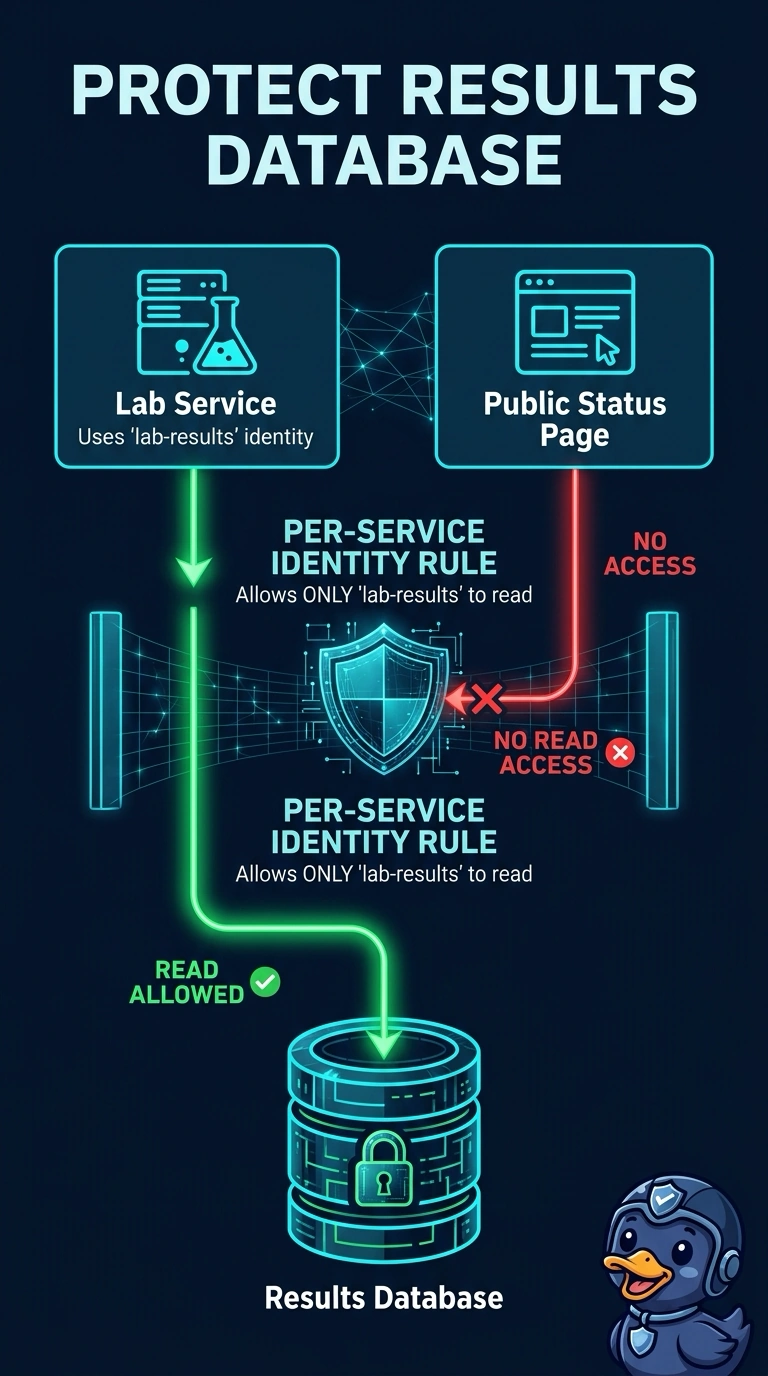
Sharing a hallway is not the same as handing over the lab key. You allow only the lab-results identity to read the results database. A namespace-wide allow, a perimeter rule on the status page, or a virtual-machine security group gives access to the wrong neighbor.
Full Explanation
A namespace is an administrative grouping, not a trust boundary, when a public status page and a lab service share it, so a namespace-wide allow would let the status page read results. Per-service identity can allow only the lab-results identity to open the database and deny the status page in that shared namespace. The perimeter in front of the status page is on a different flow, and there is no guest interface for a virtual-machine group. A per-service identity rule that allows only the lab-results identity to read the database is the design that meets this requirement. A namespace rule that allows every service in the namespace to read the results database is the wrong fit because a namespace allow treats the public status page as trusted enough to read the lab results database. A perimeter firewall in front of the public status page that does not query the database is the wrong fit because the status page is not the database client, so a firewall in front of it does not enforce the read. A virtual-machine security group on a guest interface these services do not present is the wrong fit because these services do not present a guest interface, so that security group has nothing to attach to. Exam caveat: If the status page is later given the lab identity by a shared service account, the per-service rule collapses, so each workload needs its own identity. Operational check: From the lab namespace, confirm the lab-results identity can read a test record and the status-page identity is denied, even though both identities run in that same namespace.