
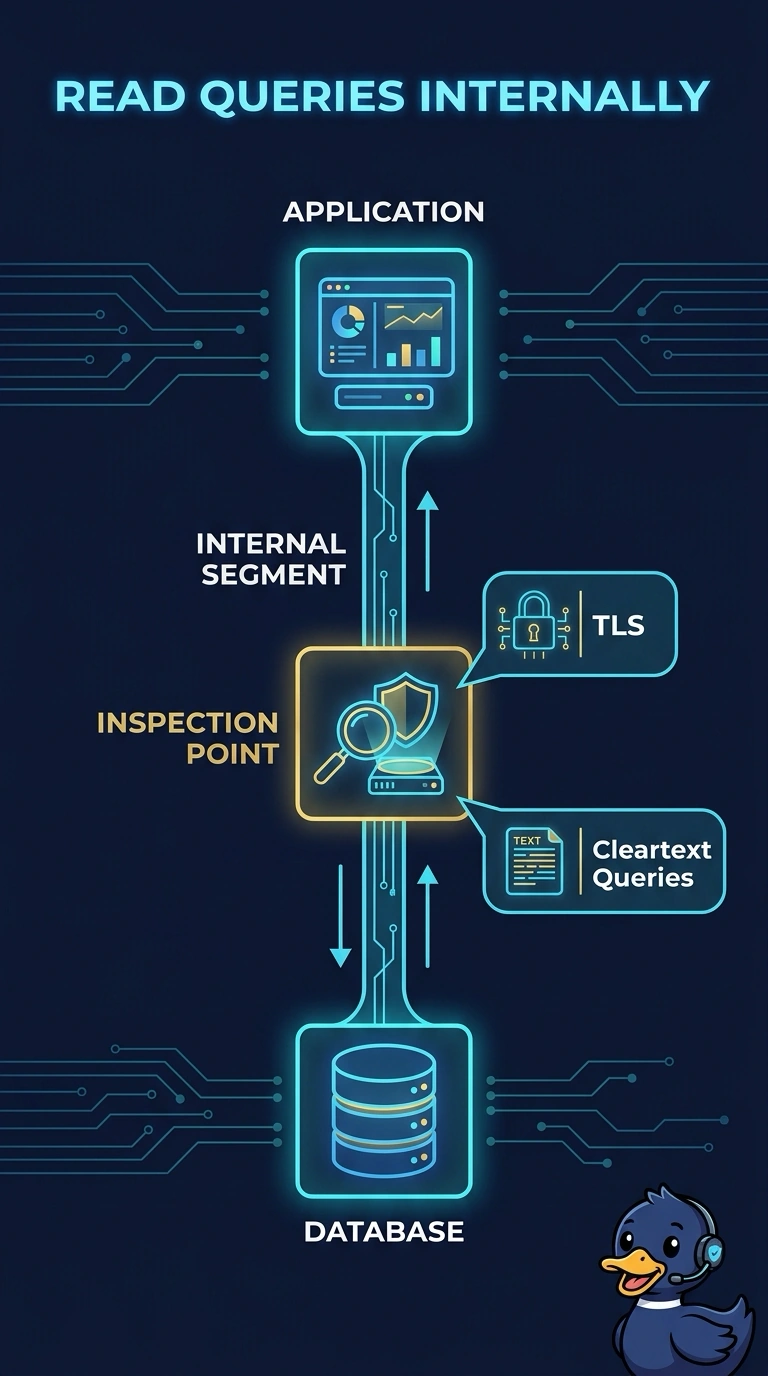
A publisher's website terminates TLS at the edge, and the app then sends cleartext queries to a database the edge does not route. Where can a control read those queries?
Select an answer to reveal the explanation.
Short Explanation
The package you care about stays on an inside hallway, so the guard at the front gate cannot open it. You inspect on the segment between the app and the database. Edge TLS offload, a mail policy, or a guest-wireless filter is watching a different path.
Full Explanation
Terminating browser TLS at the edge reveals the public HTTP session and nothing after it. The application opens a separate cleartext conversation to the database on an internal segment the edge does not route, so the offload is not on that flow. A control that can read the queries has to sit on the internal segment, and mail policy and lobby wireless are other paths entirely. An inspection point on the internal segment between the application and the database is the design that meets this requirement. The edge TLS offload that sees browser sessions and not the internal database queries is the wrong fit because the offload ends the browser session, and the queries are a new flow the edge does not carry. A mail data-loss policy that inspects messages and does not sit on the database path is the wrong fit because mail inspection reads mailbox messages, not the queries the application sends to the database. A guest-wireless filter in a lobby that does not host the application or the database is the wrong fit because lobby wireless is a different network, so its filter has no copy of the internal database flow. Exam caveat: If that internal segment is later encrypted, the same inspection point has to be able to read the query text or it will be blind again. Operational check: Run a test query from the application and confirm the internal inspection log shows it, while the edge offload log shows only the browser request and not the query text.