
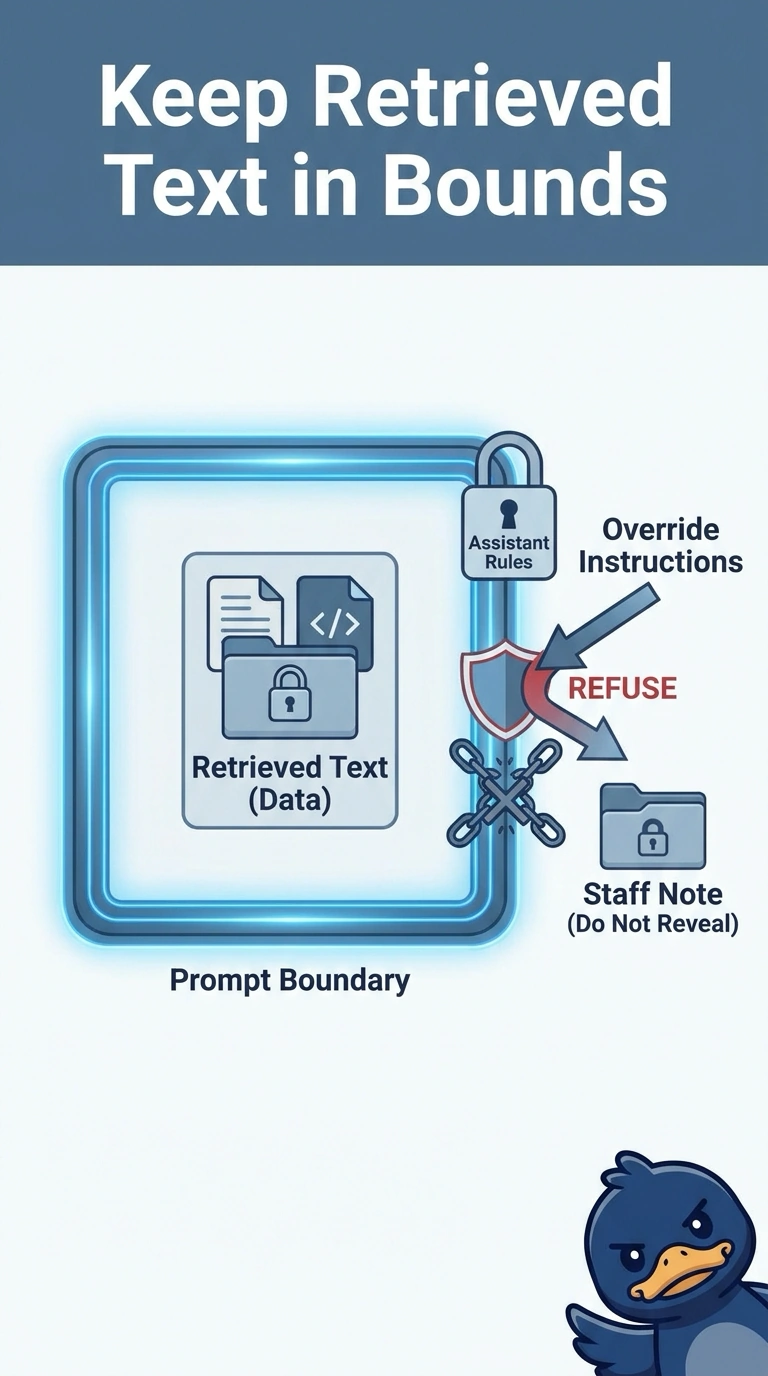
A museum chatbot answers from exhibit text, and a visitor comment hidden in that text tells the bot to ignore its rules and reveal a staff note. Which control fits?
Select an answer to reveal the explanation.
Short Explanation
A scrap of paper slipped into a library book must not be allowed to rewrite your librarian’s job. You treat retrieved exhibit text as untrusted data and refuse instructions that try to override the assistant’s rules. A no-training clause, a crypto-agility plan, or extra protection for a separate model’s training set leaves this live prompt vulnerable.
Full Explanation
The visitor comment is untrusted data within retrieved exhibit text, and it tries to replace the assistant’s rules. Treat retrieved text as data, inspect it for injection, and enforce document authorization before retrieval so an injected instruction cannot expose the staff note. A prompt boundary that treats retrieved text as data and refuses instructions that try to override the assistant’s rules addresses this live prompt path and prevents the comment from directing the assistant to release the note. A no-training clause that only stops the vendor from learning on the museum’s prompts does not stop the assistant from obeying hostile text already retrieved. A crypto-agility plan for rewrapping archived catalogs if new computers break old ciphers protects stored catalogs, not the assistant’s behavior when following a prompt. Extra protection on the training set of a separate model the museum is not retraining concerns a training process that is not happening, so it does not protect this live interaction. Exam caveat: keep the staff note out of the retrieval set if the assistant should not have access to it at all. Practical check: test with a lab record that instructs the assistant to release a test note and confirm that it refuses.