
On a shipping firm's cluster, tracking and payroll share a subnet, and only the tracking workload may call the tracking API. Which control enforces that?
Select an answer to reveal the explanation.
Short Explanation
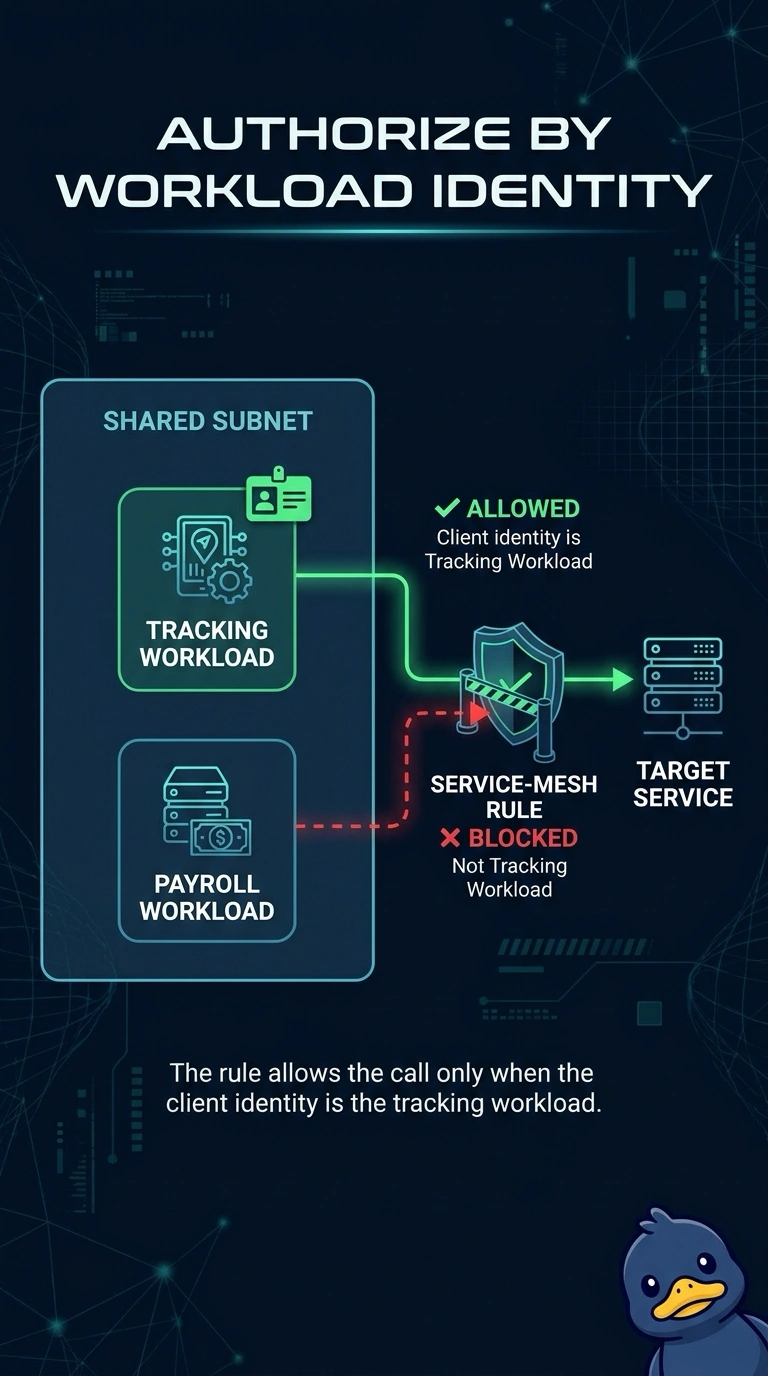
Two desks on the same floor are not the same worker merely from sharing a hallway. You allow the tracking call only when the mesh sees the tracking workload identity. A subnet list for every address, a warehouse-edge firewall, or a firewall on the warehouse PCs does not keep payroll off that API.
Full Explanation
Payroll and tracking share addresses on one subnet, so a subnet allow cannot tell them apart. The mesh sees the workload identity on the call and permits the tracking identity only. The warehouse-edge firewall is outside this path, and a firewall on warehouse PCs is not where the call starts, because same-subnet reachability is not permission to call the API and the mesh is the place that can name the caller. A service-mesh rule that allows the call only when the client identity is the tracking workload is the design that meets this requirement. A subnet access list that permits every address on the shared cluster subnet is the wrong fit because a subnet list treats payroll and tracking as the same source, so payroll can still call the API. A perimeter firewall at the warehouse edge that does not sit on the path between these pods is the wrong fit because pod-to-pod calls stay inside the cluster and are not inspected by the warehouse-edge firewall. A personal firewall on warehouse PCs that do not originate these service-to-service calls is the wrong fit because these calls start on the cluster nodes, so a firewall on warehouse PCs does not evaluate them. Exam caveat: Identity on the mesh does not help if the tracking API also listens on a direct path that bypasses the mesh, so that bypass has to be closed. Operational check: From a lab payroll identity, call the tracking API and confirm the mesh denies it, then repeat as the tracking identity and confirm the call succeeds.