
Two business units at a textile mill share one cluster. Each unit's pods must reach only that unit's database. No service mesh will be installed this quarter. Which segmentation fits now?
Select an answer to reveal the explanation.
Short Explanation
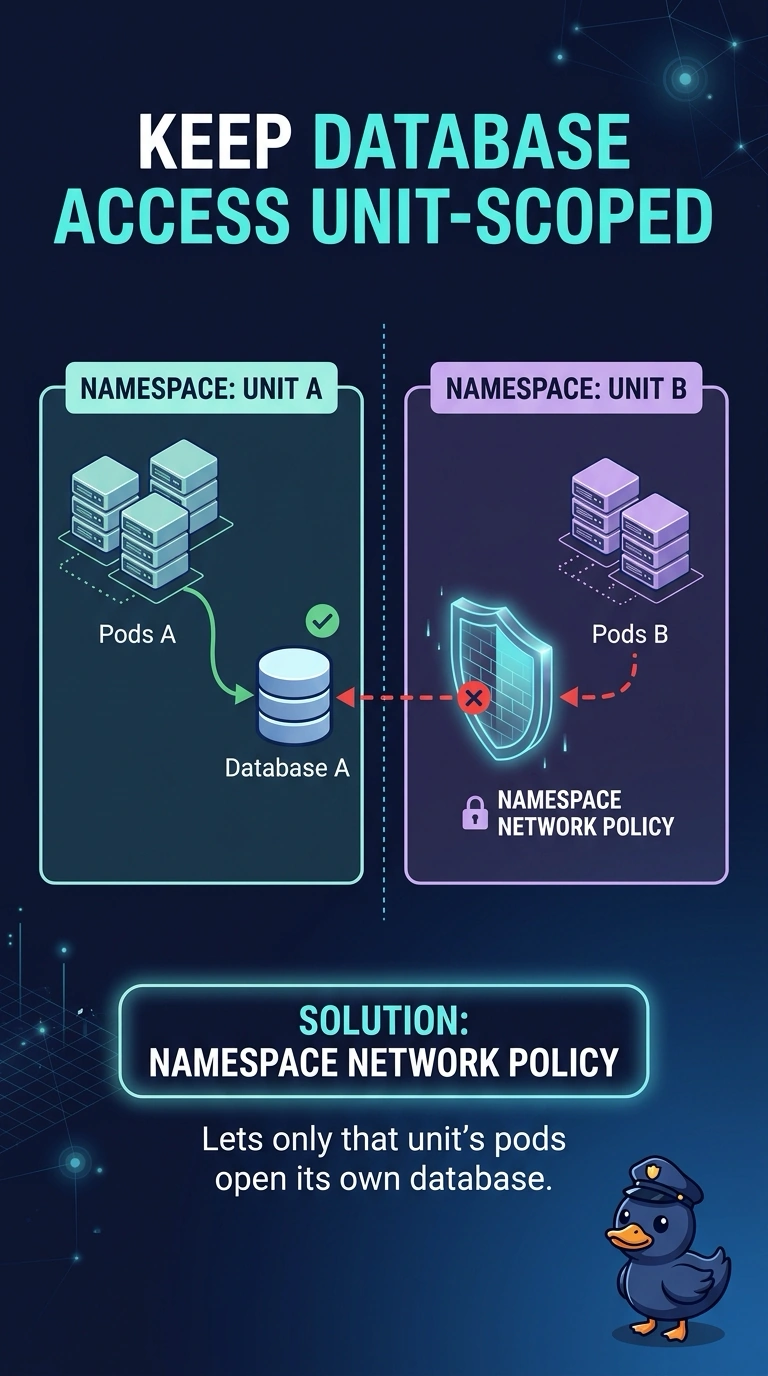
You can keep the units’ database access separate with a namespace network policy that lets each unit’s pods reach only its own database. A service-mesh identity rule cannot help when the mill will not install a mesh this quarter, and the perimeter firewall is off the pod-to-database path. A node security group treats both units as one subnet, so it cannot separate their pods.
Full Explanation
No service mesh will be installed this quarter, and the pod-to-database traffic stays inside the cluster, so a namespace network policy is the fit that can limit each unit’s pods to its own database now. A service-mesh identity rule cannot enforce separation on a mesh the mill will not install this quarter. A perimeter firewall sitting off the pod-to-database path cannot segment these database calls, because they stay inside the cluster rather than crossing that firewall. A node security group that treats both units as one subnet on the shared workers cannot distinguish one unit’s pods from the other’s, so it cannot provide the required separation. The namespace network policy meets the requirement by allowing only that unit’s pods to open its own database. Exam caveat: A pod launched into the wrong namespace may inherit that namespace’s reach, so admission must keep each unit’s labels honest before you can trust the policy. Practical check: From a pod in the other unit’s namespace, confirm the database port is refused; from a pod in the owning namespace, confirm the connection opens.