
An internal inventory page at a winery uses plain HTTP on the server VLAN and includes customer account numbers in the response. Nothing encrypts that hop. Which control can see the numbers?
Select an answer to reveal the explanation.
Short Explanation
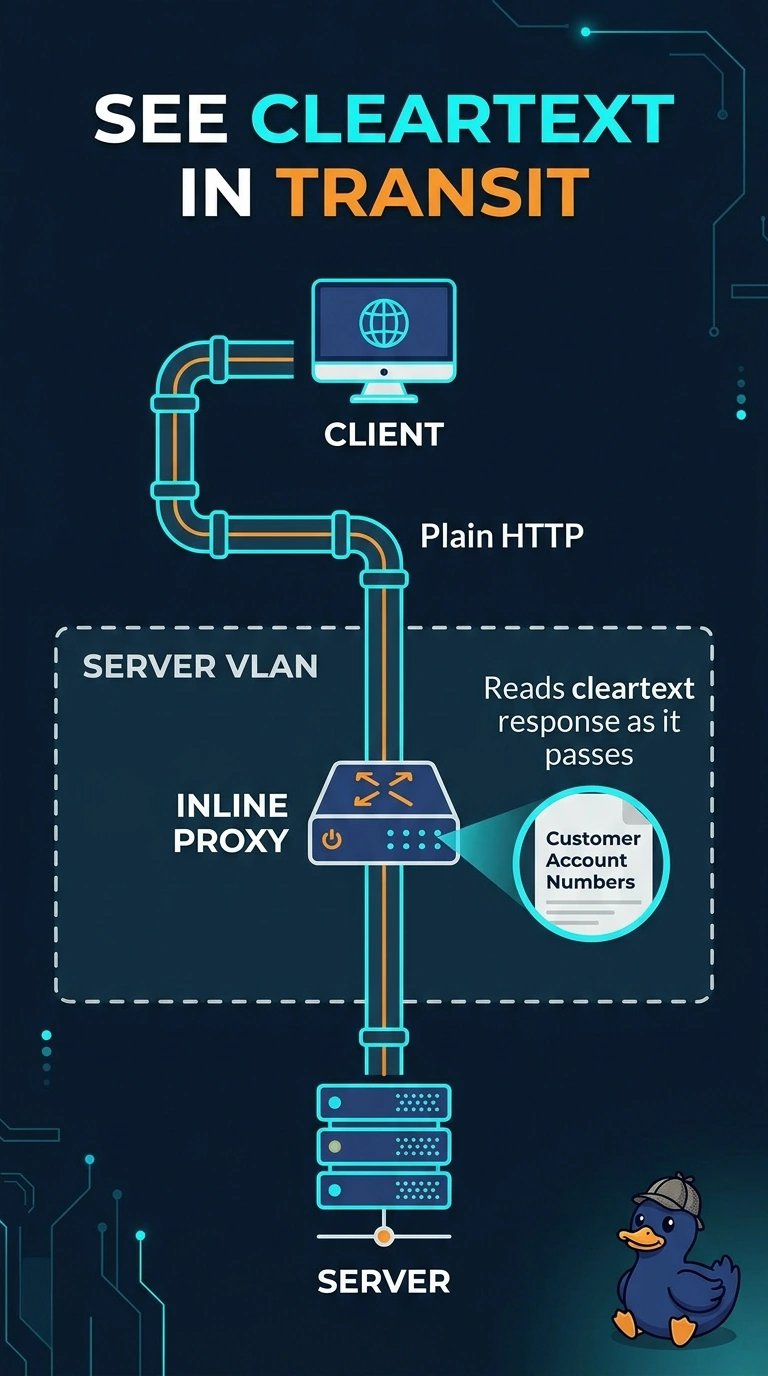
You do not need a locksmith when the letter is already open on the table. You read the cleartext inventory response with an inline proxy on that VLAN. TLS decryption, a tasting-room tablet agent, or a mail rule is not on this hop.
Full Explanation
Those account numbers already travel in the clear on the server VLAN, so an inline proxy on that path can read the page with no decryption step. A TLS decryption rule has no protected session to open here, and tasting-room tablets do not load this internal page. Mail inspection is not on the path between the inventory servers, so it cannot see the response. An inline proxy on that VLAN that reads the cleartext response as it passes is the design that meets this requirement. A TLS decryption rule aimed at a hop that is not encrypted to begin with is the wrong fit because decryption opens a TLS session, and this hop is already readable without any decryption step. An endpoint agent on tasting-room tablets that do not load this inventory page is the wrong fit because tasting-room tablets are not the clients of the internal page, so an agent there never sees the numbers. A mail inspection rule that does not sit between the inventory servers at all is the wrong fit because mail inspection reads messages, not an HTTP response moving between these inventory servers. Exam caveat: Cleartext on the VLAN is why the proxy can read the page, and that is not a reason to leave the same page reachable from the tasting room or the internet. Operational check: Request the lab inventory page through the proxy and confirm the log shows a customer account number, and confirm a client that bypasses the proxy is blocked.