
A freight broker's public booking API receives account numbers inside HTTPS posts, and a content rule must read those numbers. Which control can see that flow?
Select an answer to reveal the explanation.
Short Explanation
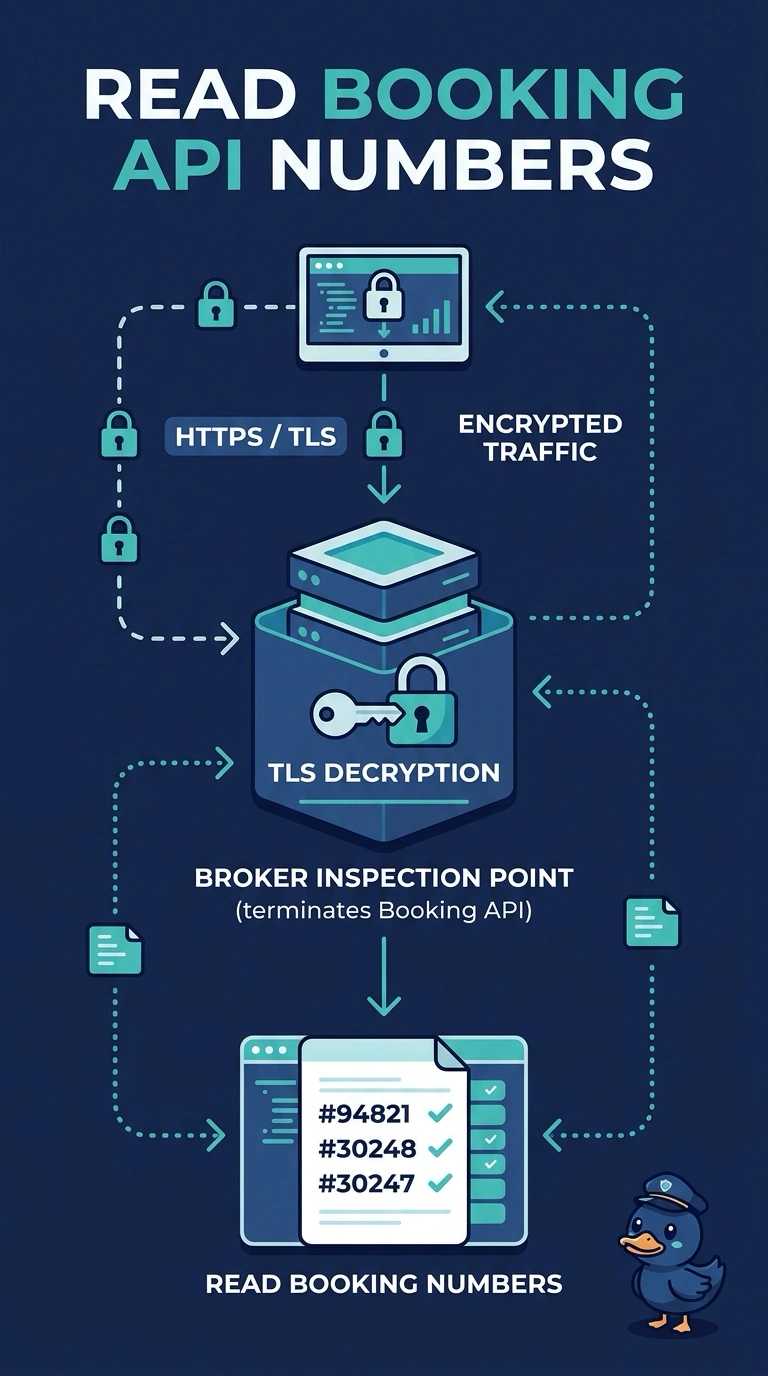
A sealed envelope hides the letter from anyone who can read only the address on the outside. You decrypt TLS at the broker's booking front door so the content rule can see the account numbers. An address-and-port firewall, a sensor full of ciphertext, or an agent on the shipper laptop cannot read that post.
Full Explanation
The account numbers exist in the HTTP body, and HTTPS hides that body from anything that only sees packets. The inspection point that terminates the booking TLS can decrypt that session and run the content rule. A port rule, a span of ciphertext, and an agent on a laptop the broker does not manage do not reveal this body, and the content rule needs the cleartext that decryption at that front door produces. TLS decryption at the broker inspection point that already terminates the booking API is the design that meets this requirement. A firewall rule that matches internet addresses and TCP port numbers and nothing inside the post is the wrong fit because addresses and ports do not include the account number sitting inside the encrypted booking post. A span-port recorder that stores the same posts while the body is still ciphertext is the wrong fit because a stored copy of ciphertext still hides the body, so the recorder cannot apply a content rule to the numbers. An endpoint agent on shipper laptops the broker does not own or manage is the wrong fit because the shipper laptop is outside the broker's control and is not the inspection point for this API. Exam caveat: Decrypt the booking API the broker owns, and leave unrelated staff browsing encrypted unless that browsing is a separate, reviewed inspection. Operational check: Post a lab booking with a test account number and confirm the inspection log shows that number, while a packet capture outside the inspection point shows only ciphertext.