
A property-software host runs every customer's pods in one cluster, and those pods can already route to every data store. The store must refuse the wrong customer. Which control enforces that?
Select an answer to reveal the explanation.
Short Explanation
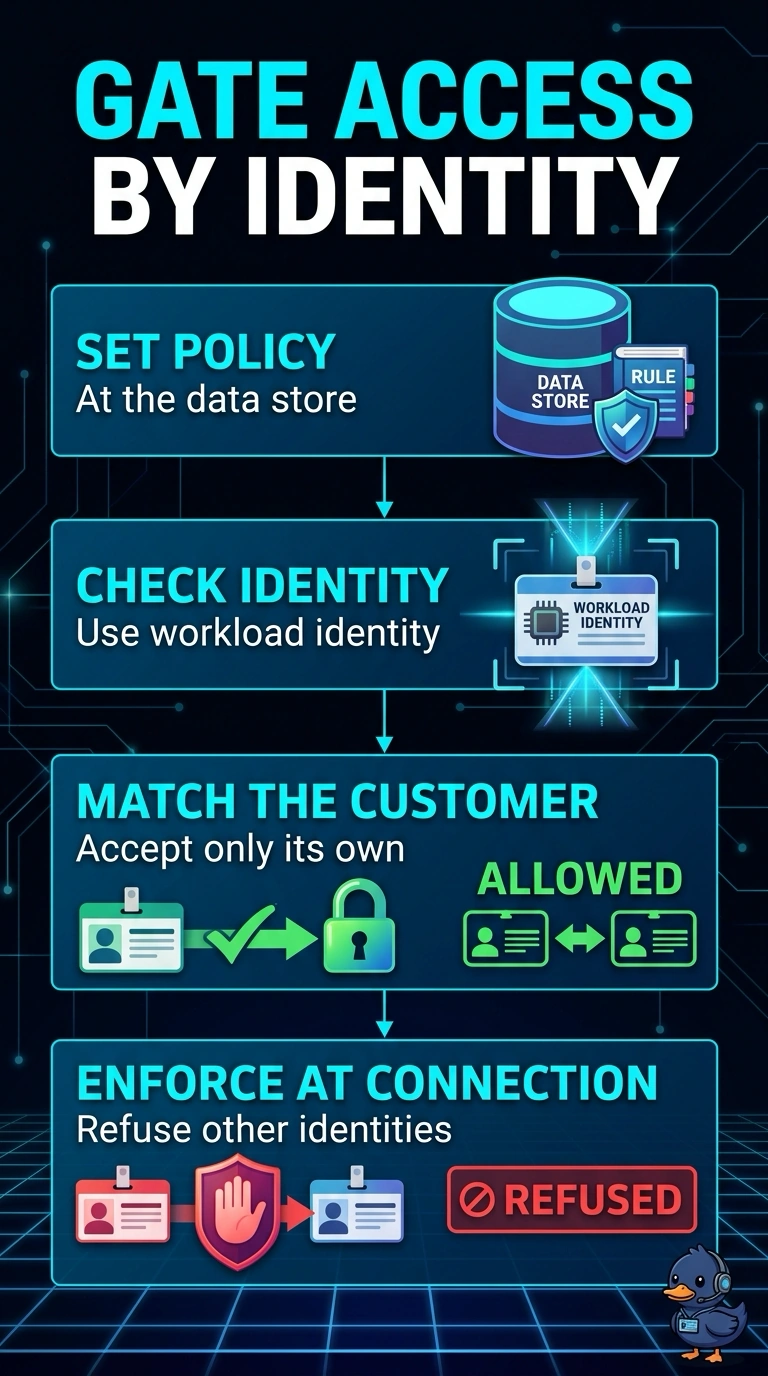
When every pod can reach every store, you need the data store to recognize which customer is asking. Accepting only that customer's workload identity enforces the tenant boundary. An office-edge firewall, an address list that permits every pod, or a password shared across customer images does not make the store refuse the wrong customer.
Full Explanation
Because pods can already route to every data store, the store must decide whether the connecting workload belongs to the customer whose data it holds. A data-store policy that accepts only that customer's workload identity makes the store enforce this tenant boundary, even when network reachability is shared. An office-edge firewall rule filters sessions entering the company building network, not the already-routable pod-to-store connections described here. A cluster address list that permits every pod to open every customer data store explicitly allows the cross-customer access the store must refuse. A shared database password compiled into every customer image gives those workloads the same secret, so it does not distinguish one customer's pod from another. Exam caveat: workload-identity enforcement at the store answers who may access it; it does not itself limit which pods can attempt a connection, so identity checks do not replace a needed network boundary. Practical check: from a lab pod belonging to customer A, request customer B's store and verify that the store refuses the identity; then request customer A's own store and verify that it accepts the identity.