
A paper mill's scoring service loads whatever file is named as the quality model. Folder access is already limited, and someone replaced that file with an unsigned lookalike that the service still scored. Which design protects the model?
Select an answer to reveal the explanation.
Short Explanation
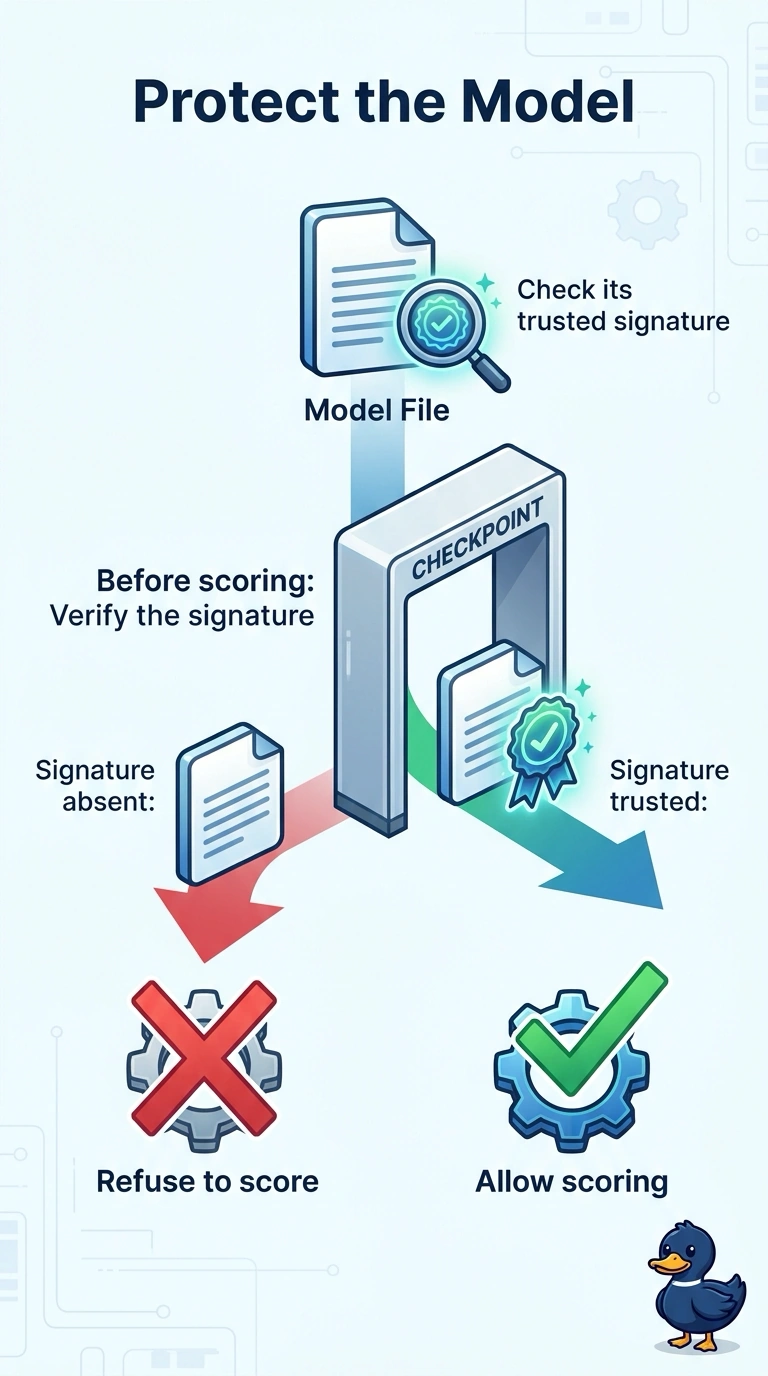
Knowing who may enter the room does not prove the jar on the shelf is the real one. You verify a trusted signature and refuse to score an unsigned file. A training-row allow list, a chatbot prompt boundary, or a crypto-agility plan does not check that jar.
Full Explanation
Folder permissions limit who can reach the share, but they do not prove that the file with the expected name is authentic; the service scored an unsigned lookalike despite restricted access. Verifying a trusted signature before loading the model and refusing to score when it is absent ties the decision to the model’s authenticity, not its filename. An allow list for training rows addresses which examples are accepted, not whether the loaded model file was replaced, so it does not stop this failure. A prompt boundary on a chatbot the mill does not use on this scoring path separates instructions in a chat product and cannot authenticate the file. A crypto-agility plan for archived secrets addresses long-lived cryptographic material, not the signature of the quality model about to be scored. Exam caveat: The signature check must run in the service that loads the model; a signature recorded in a build log but never enforced will not stop the scorer opening an unsigned file. Practical check: Point a lab scorer at an unsigned lookalike bearing the production filename and confirm it refuses to score, then confirm the signed model loads.