
A bookstore checkout ends customer TLS on its own service, then sends a token rather than the card number to the payment processor. Staff need the card numbers visible to a control. Which control can see them?
Select an answer to reveal the explanation.
Short Explanation
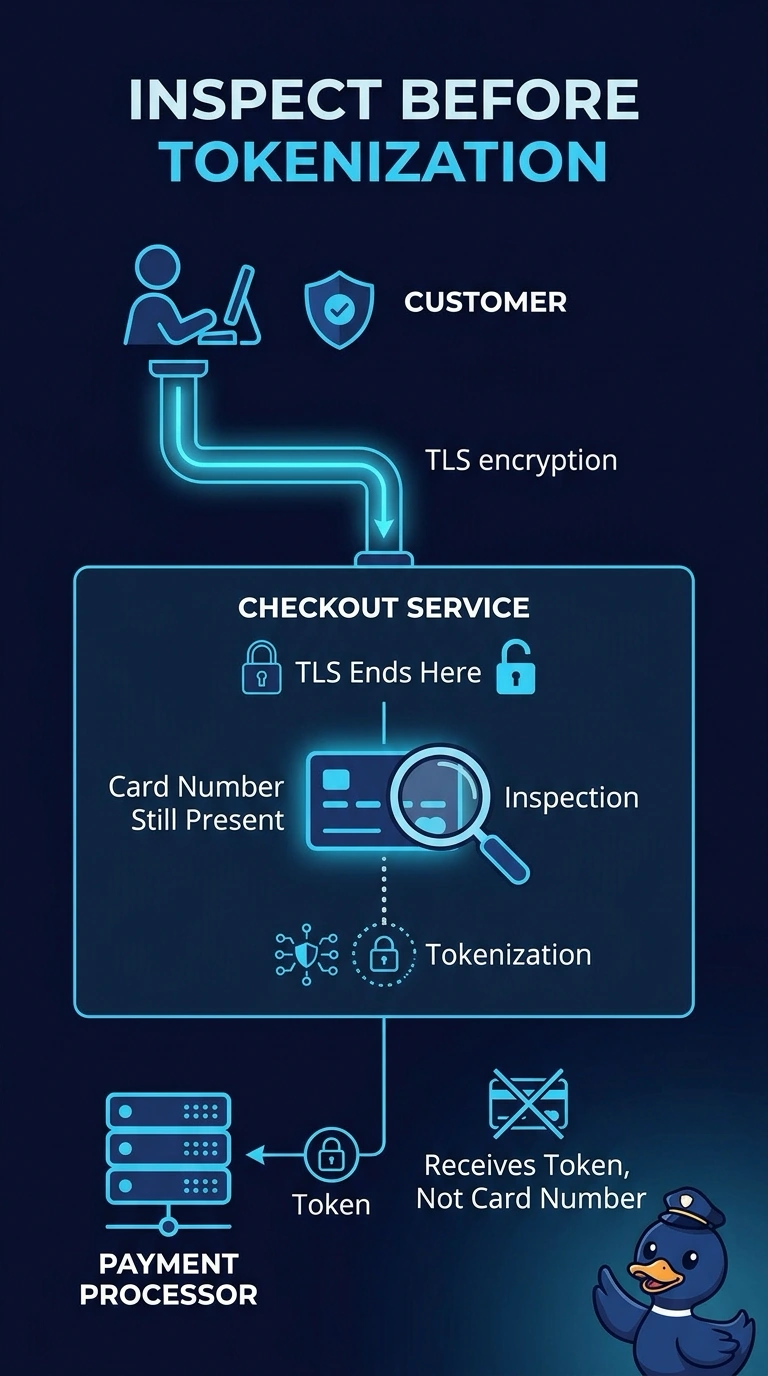
Think of the checkout service as the counter where you can see the card number before it is swapped for a claim ticket. Inspect that service, where customer TLS ends and the number is still present. Decrypting the processor session, allowing a port without reading the request body, or relying on an agent on a shopper’s phone won’t reveal the number.
Full Explanation
The card number is visible on the checkout service because that is where customer TLS ends; it is replaced with a token before the processor session. Inspection on the checkout service therefore meets the requirement: it can see the number while it is still present. Decrypting the processor session that carries a token in place of the card number is the wrong fit because that session begins after tokenization, so inspection there reveals the token rather than the card number. A firewall allow for the checkout port that does not read the customer request body is also the wrong fit: it permits the connection but does not inspect the number inside the request. An endpoint agent on shopper phones that the bookstore does not own or manage is not a suitable control, since those phones are unmanaged and the bookstore cannot rely on installing an agent there to observe this flow. Exam caveat: Place inspection on the checkout service where the bookstore terminates customer TLS; the processor hop already carries a token, and extending inspection to unmanaged shopper phones widens the design without exposing the number. Practical check: Submit a lab payment using a test card number, confirm that checkout inspection sees the number, and verify that the processor capture shows a token instead.