
At a harbor terminal, only the billing service may call the ledger service. Both run as pods on shared workers, and that traffic never crosses the internet firewall. Which control enforces the limit?
Select an answer to reveal the explanation.
Short Explanation
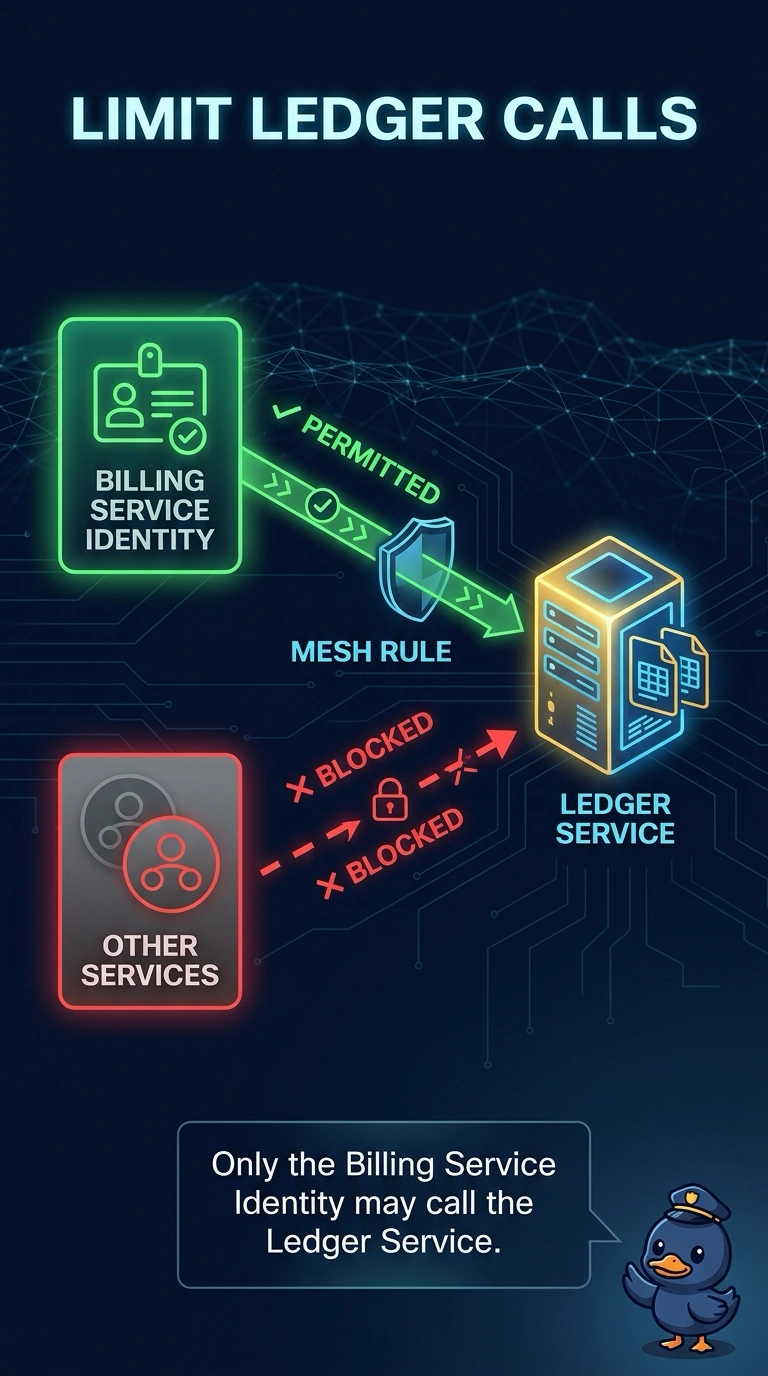
The ledger should recognize one clerk, not everyone who can reach the building. You allow the call only from the billing service identity on the mesh. An internet firewall, a worker security group, or a password baked into both images cannot name that caller.
Full Explanation
The ledger call stays on the shared workers, so a mesh rule can require the billing service identity and refuse every other pod. An internet firewall is not on that path, and a node security group cannot tell the billing pod apart from the others on the subnet. A password baked into both images is a shared secret any copy of an image can present, not an identity bound to billing. A mesh rule that permits the ledger call only from the billing service identity is the design that meets this requirement. An internet firewall policy written only for the cluster's published address is the wrong fit because pod-to-pod calls stay on the workers, so an internet firewall never sees the ledger conversation. A worker security group that opens the ledger port to the whole node subnet is the wrong fit because a security group on the node cannot tell the billing pod from any other pod sharing that subnet. A shared password baked into both service images and checked by the ledger is the wrong fit because a password shipped in both images is a shared secret, and anyone who holds an image can present it. Exam caveat: Mesh identity only helps if the ledger workload actually enforces the mesh policy and does not also listen for the same call in plaintext beside it. Operational check: From a non-billing pod in a lab cluster, confirm the ledger call is refused, and from the billing identity confirm the same call succeeds cleanly.