
A hotel chain's booking microservices call each other across a cluster. Any stolen service should not be able to impersonate the rates service to the inventory service. Which segmentation design fits?
Select an answer to reveal the explanation.
Short Explanation
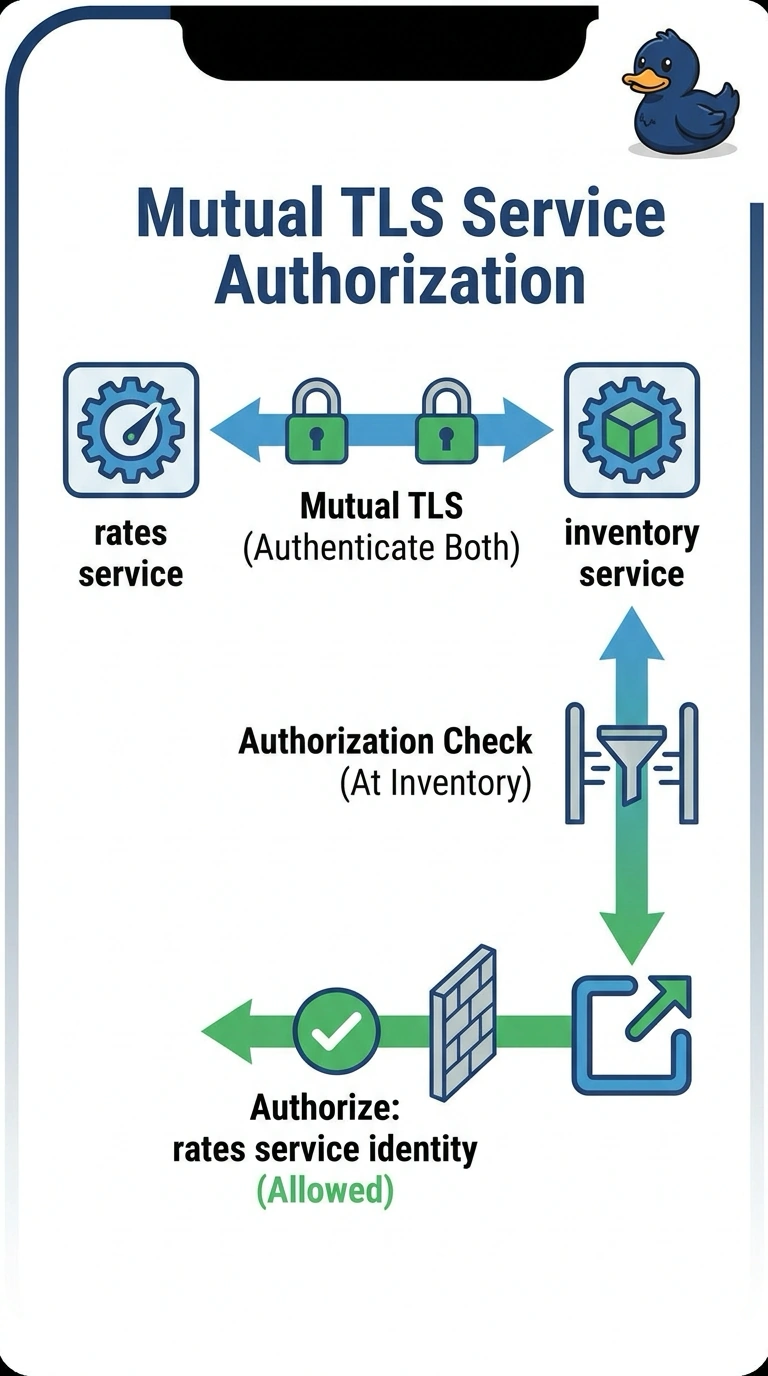
A borrowed badge that everyone wears is not a badge. You give each service its own certificate and you require both sides to prove it. A shared password, an edge firewall, or a flat network lets the stolen neighbor pretend to be rates.
Full Explanation
Impersonation inside the cluster is an identity problem between services. Mutual TLS gives each service a certificate and requires both ends to prove identity. Inventory must check that the authenticated peer is the expected rates identity. A shared password makes every holder identical. A perimeter firewall and a flat network do not name the caller. Mutual TLS between services, each with its own certificate identity is the design that meets this requirement. One shared API password compiled into every service image is the wrong fit because a shared password in every image lets the stolen service present the same secret the inventory service trusts. A perimeter firewall that never sees calls inside the cluster is the wrong fit because calls that stay inside the cluster never cross the perimeter firewall. A single pod network with no identity and no policy between services is the wrong fit because a flat network with no identity cannot tell a stolen service from the rates service. Exam caveat: Certificate rotation has to be automatic. A mutual TLS design that nobody can renew will be bypassed the first time a certificate expires on a holiday. Operational check: From a lab pod that does not hold the rates certificate, call inventory and confirm the handshake fails, then confirm the real rates pod succeeds.