
A retailer's checkout runs as containers. The payment service must accept calls only from the checkout service, and the catalog service must not reach the card database. Which design enforces that segmentation?
Select an answer to reveal the explanation.
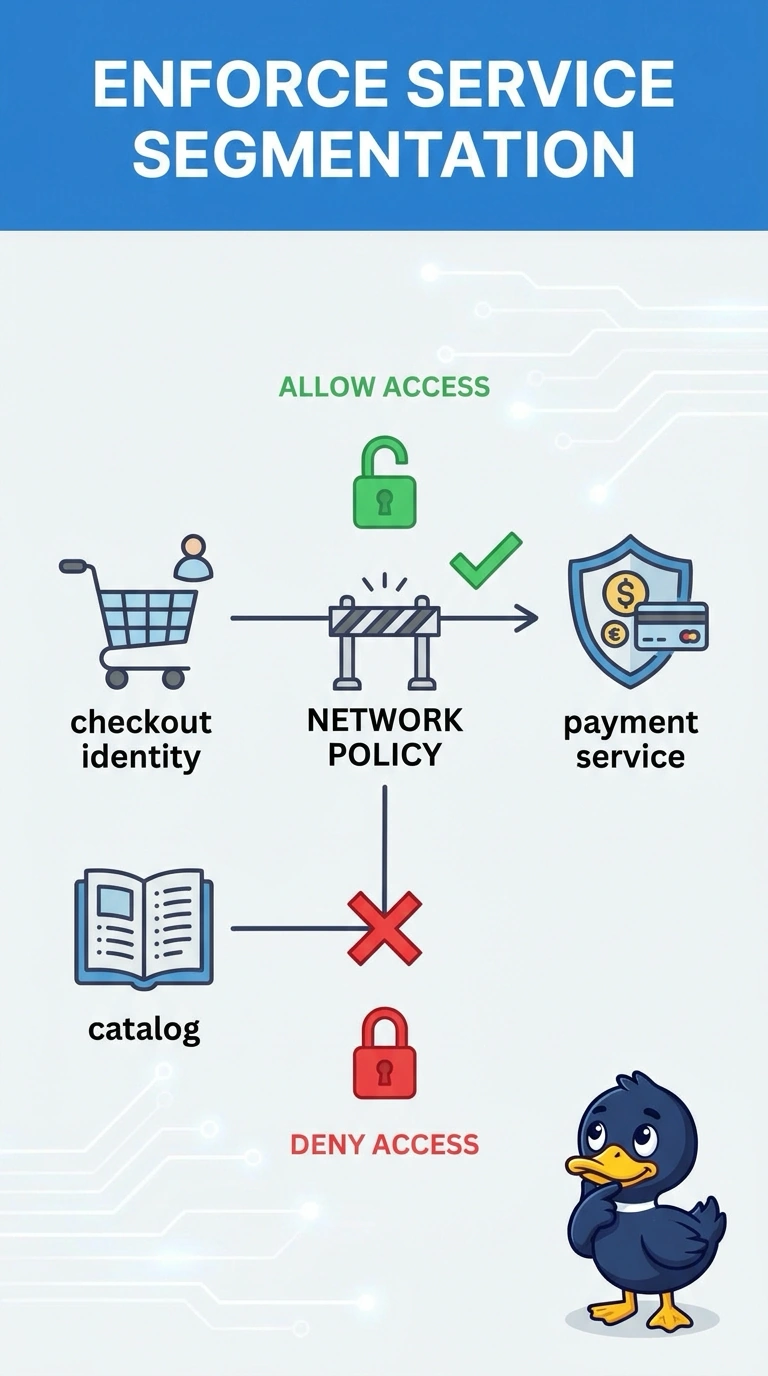
Short Explanation
Inside a warehouse, the loading dock camera does not watch the hallway between two rooms. You write a hallway rule that lets only checkout talk to payment and stops catalog from the card data. A flat network, an edge firewall, or one shared account leaves those rooms connected.
Full Explanation
Container segmentation is a policy on the identities of the workloads, enforced in the cluster, because the packets between payment and catalog never cross the data-center edge. Allowing only the checkout identity to reach payment, and denying catalog toward the card database, matches the two rules the retailer stated. The policy has to be able to tell the services apart. Network policy that allows only the checkout identity to the payment service and denies catalog is the design that meets this requirement. One flat pod network where every service can open a connection to every other service is the wrong fit because a flat pod network is the opposite of the required separation and lets catalog reach the card database. A perimeter firewall in front of the cluster and no policy between the services is the wrong fit because a perimeter firewall never sees pod-to-pod traffic that stays inside the cluster. A single shared service account used by checkout, payment, and catalog alike is the wrong fit because a shared account erases the identity the policy would use to tell checkout from catalog. Exam caveat: Identity in the policy must match the identity the platform actually assigns. A label nobody enforces is not segmentation. Operational check: From a catalog pod, attempt the card database and confirm the deny, then from a checkout pod confirm the payment call succeeds.