
A research hospital stores imaging archives that must stay confidential for decades. An assessor warns that an attacker could record today's encrypted transfers and decrypt them years later with a future quantum computer. Which design policy addresses that impact?
Select an answer to reveal the explanation.
Short Explanation
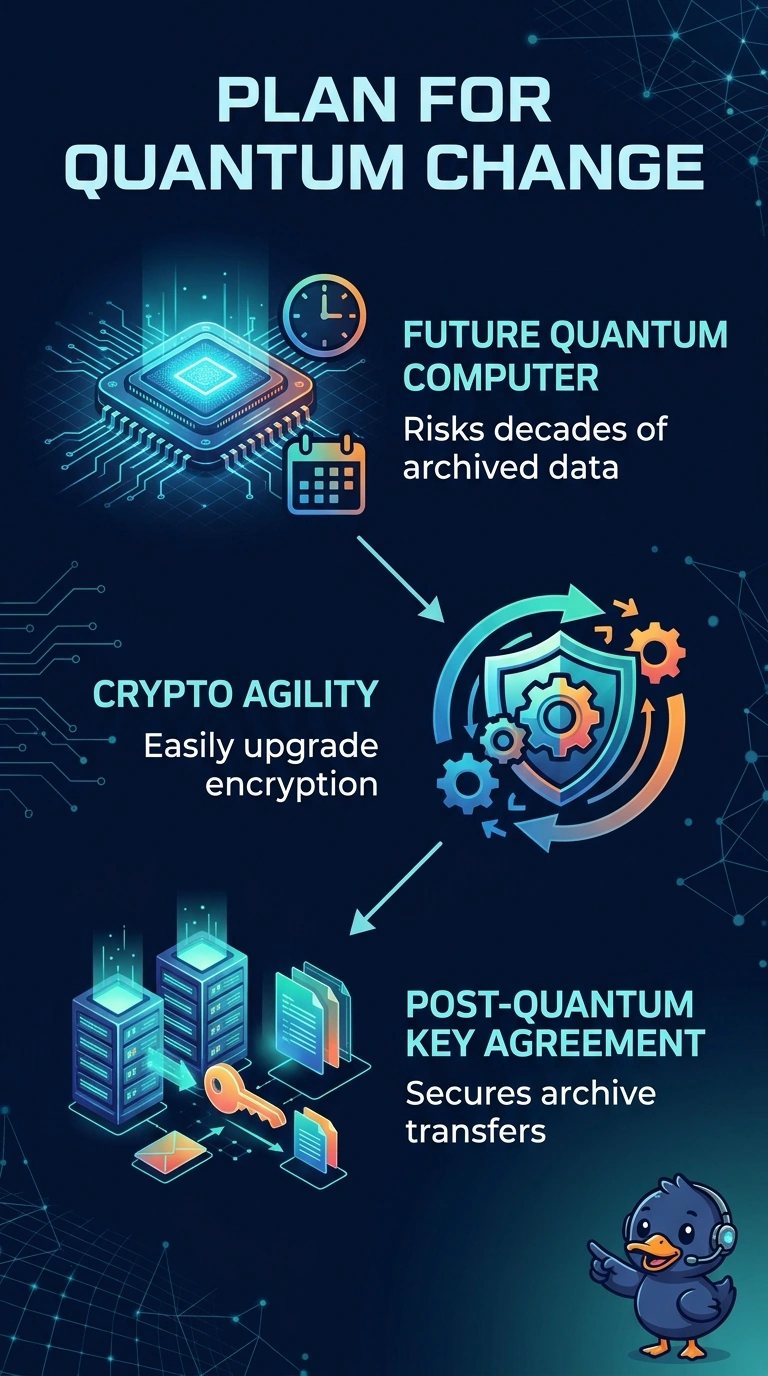
Someone is photocopying the locked box, betting they can cut the lock years from now. You design the transfer so you can change the lock, not merely make the old key longer. Turning encryption off or parking a web firewall in front of the viewer does not protect a decades-long secret.
Full Explanation
Harvest-now-decrypt-later is about ciphertext recorded today and decrypted when the key agreement can be broken. Data that must stay secret for decades is in scope. Crypto agility means the transfer can adopt a post-quantum key agreement without rebuilding the archive application, and new sessions stop using a classical-only exchange. That is a design policy, not a single firewall rule. Crypto agility so the archive transfers can move to post-quantum key agreement is the design that meets this requirement. A longer VPN pre-shared key using the same classical key agreement is the wrong fit because a longer classical secret does not change the key-agreement math a future quantum computer would attack. Disabling encryption on the archive path so there is no ciphertext to record is the wrong fit because removing encryption exposes the images now, which is a worse outcome than a future decryption risk. A web application firewall in front of the imaging viewer is the wrong fit because a web application firewall does not change how the archive session keys are agreed. Exam caveat: Post-quantum key agreement does not by itself re-encrypt archives that were already stolen in cleartext, and inventory of long-lived data comes before the algorithm swap. Operational check: Inventory which archive flows still use classical-only key agreement, then confirm a lab transfer negotiates the updated key agreement and logs the suite.