
A regional airline's public booking site is HTTPS, and a recent test showed SQL injection in the search form. The security team may decrypt only this site, and the database must not be exposed to the internet. Which control belongs on this application flow?
Select an answer to reveal the explanation.
Short Explanation
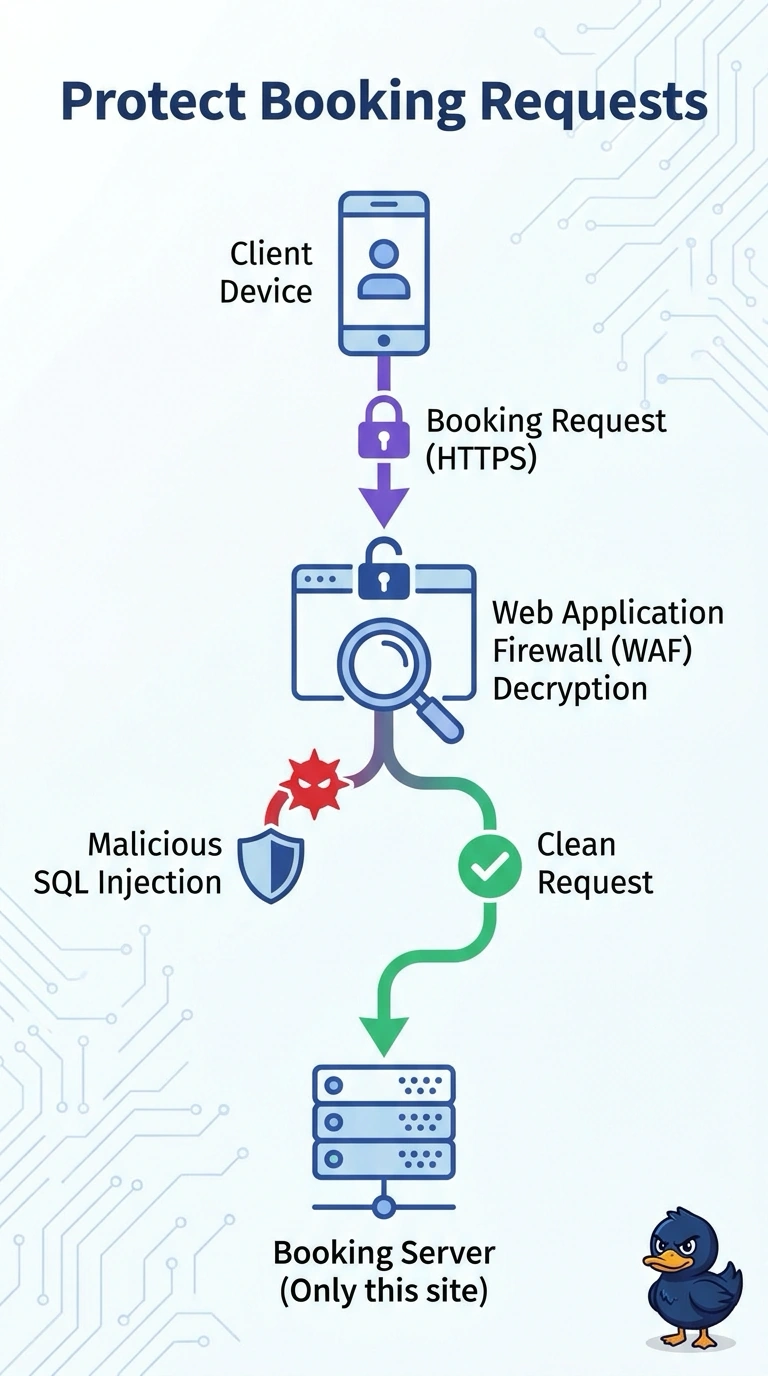
The attack is hiding inside the lock you put on the booking form, so you have to open that one lock to read it. You inspect decrypted HTTP for the booking site and leave the database off the internet. A port-443 allow, a laptop agent, or decrypting every other application misses the limit you were given.
Full Explanation
SQL injection lives in the HTTP request, inside TLS. A control that never decrypts and never parses HTTP cannot tell a booking query from an attack. Terminating TLS for this hostname on a web application firewall lets the policy inspect the form fields, block the injection pattern, and forward only clean requests to the application tier, which stays off the internet. A web application firewall that inspects the decrypted booking HTTP requests is the design that meets this requirement. A network firewall that allows TCP 443 to the booking subnet and ignores the HTTP body is the wrong fit because a port allow does not parse the search form, so the injection string still reaches the application. An endpoint agent on employee laptops, which never sees public customers is the wrong fit because customers are on the internet, not on managed laptops, so an employee agent never sees their requests. Full TLS decryption of every airline application, including the crew scheduling tool is the wrong fit because the requirement limits decryption to the booking site, and crew scheduling is a different trust decision. Exam caveat: Decrypt only where the organization is the TLS endpoint and has a lawful, documented reason; a site that uses certificate pinning or a third party's certificate is a different design. Operational check: Send a test search that contains a classic SQL metacharacter, confirm the web application firewall blocks it, and confirm a normal search still returns flights.