
A transit agency wants a model to help a weekly review board order maintenance tickets. Policy lets only the board approve a production change. Which use of the model fits?
Select an answer to reveal the explanation.
Short Explanation
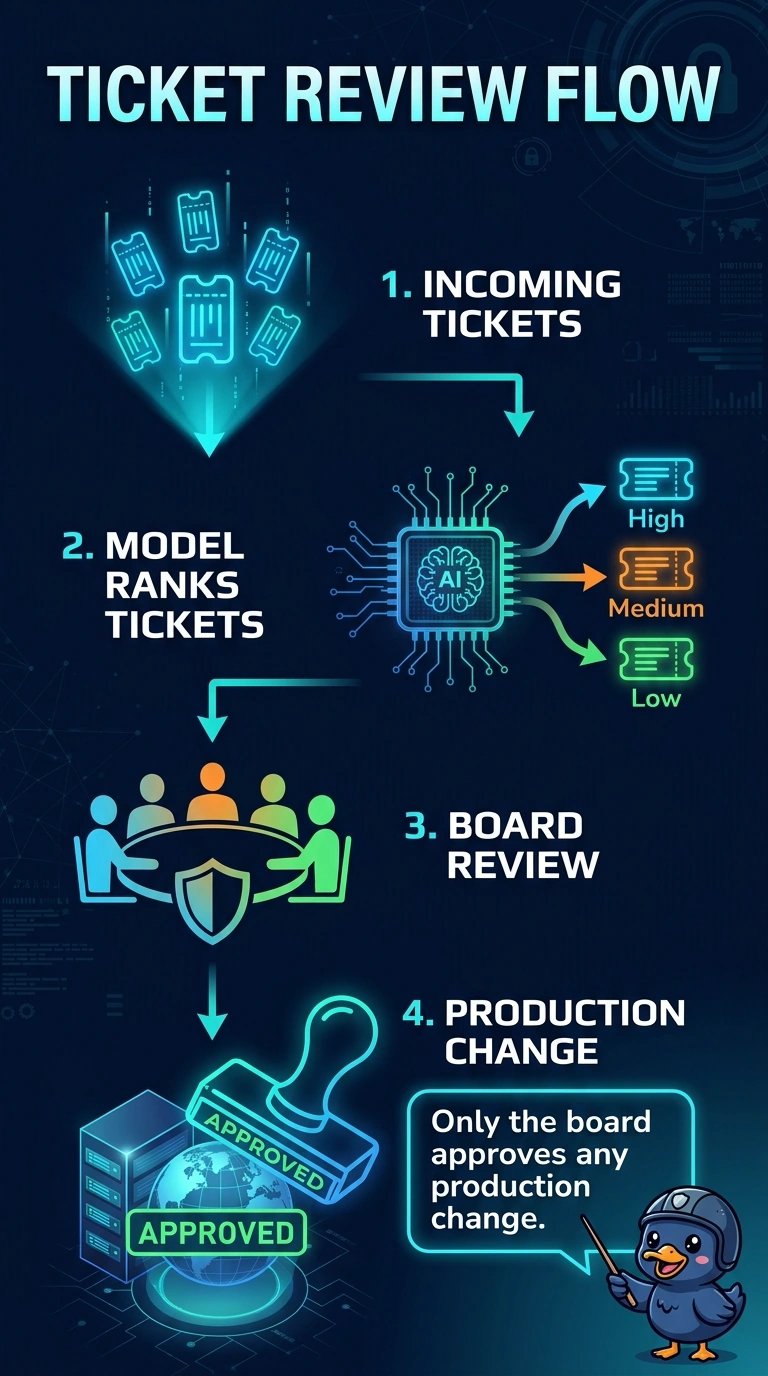
A clerk can sort the stack, and you still sign the work order. You let the model rank the tickets and you leave approval with the board. Automatic apply, disabling accounts named in the text, or a ban on reading the tickets breaks that line.
Full Explanation
The model may order the maintenance stack for people to read, and policy keeps production approval with the board, so ranking is the fitting use. Applying the top-ranked change or disabling accounts named in the text is a disruptive action the policy does not grant. Forbidding the model to read the tickets removes the ranking help without making the board's approval any stronger. The model ranks the tickets, and the board still approves any production change is the design that meets this requirement. The model approves and applies the highest-ranked change with no board review is the wrong fit because applying a production change is the decision the policy reserves for the board, not for the ranking model. The model disables operator accounts that happen to be named in the ticket text is the wrong fit because disabling accounts is a disruptive identity action, and ranking tickets was not permission to take it. The model is forbidden to read the tickets, so the board receives an unsorted pile is the wrong fit because forbidding the model to read tickets removes the ranking help and adds no approval control the policy asked for. Exam caveat: A ranking can be wrong and still be useful if the board can see why the model ordered the stack and a person can reorder it before any approval. Operational check: Run the lab ranking on a sample queue and confirm the tool cannot call the production change interface, while a board account still can approve.