
A sportswear brand's pipeline has built a release image with no signature, and the next job would promote it into production. Which pipeline step belongs next?
Select an answer to reveal the explanation.
Short Explanation
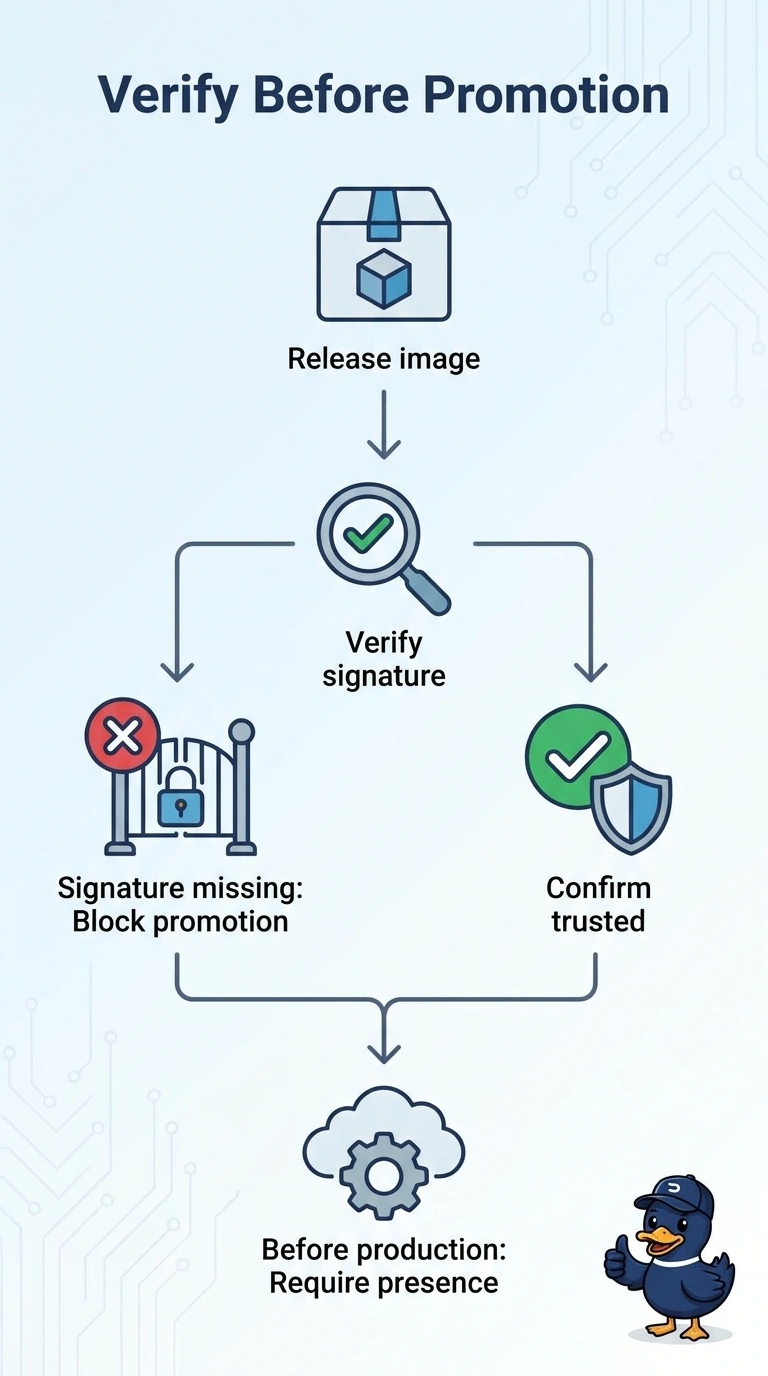
Think of the image as a crate that needs its seal before it goes on the truck. Verify a trusted signature and hold promotion until that signature is present; a public-storage policy gate, a source-diff secret block, and approval for an unapplied database migration address different gaps.
Full Explanation
The pipeline is about to promote an unsigned image into production, so verify a trusted signature on the image and block promotion until that signature is present. This ensures the image meets the pipeline’s trust requirement before it is treated as a production artifact. A policy gate that looks for a public storage account inside an infrastructure plan checks for exposed storage configuration; it does not verify the image’s signature, and the scenario does not identify such an account in a plan. A merge block aimed at a secret string in the source diff can prevent a detected secret from being merged, but it neither signs the built image nor establishes that this image has a trusted signature; no secret in the diff is identified. A second person’s approval on a database migration this pipeline is not applying does not verify the image and is unrelated to this promotion. Keep the promotion job blocked until signature verification succeeds. Exam caveat: A trusted signature supports confidence that the image came through a trusted build path, but does not establish that the image is free of vulnerable packages. Practical check: Submit an unsigned image in a lab pipeline and confirm promotion stops, then sign it with the trusted key and confirm promotion proceeds.