
A credit union changes production network rules by clicking in the cloud console. Two operators recently made different edits nobody could rebuild. Logs and alerts already exist. Which element is missing?
Select an answer to reveal the explanation.
Short Explanation
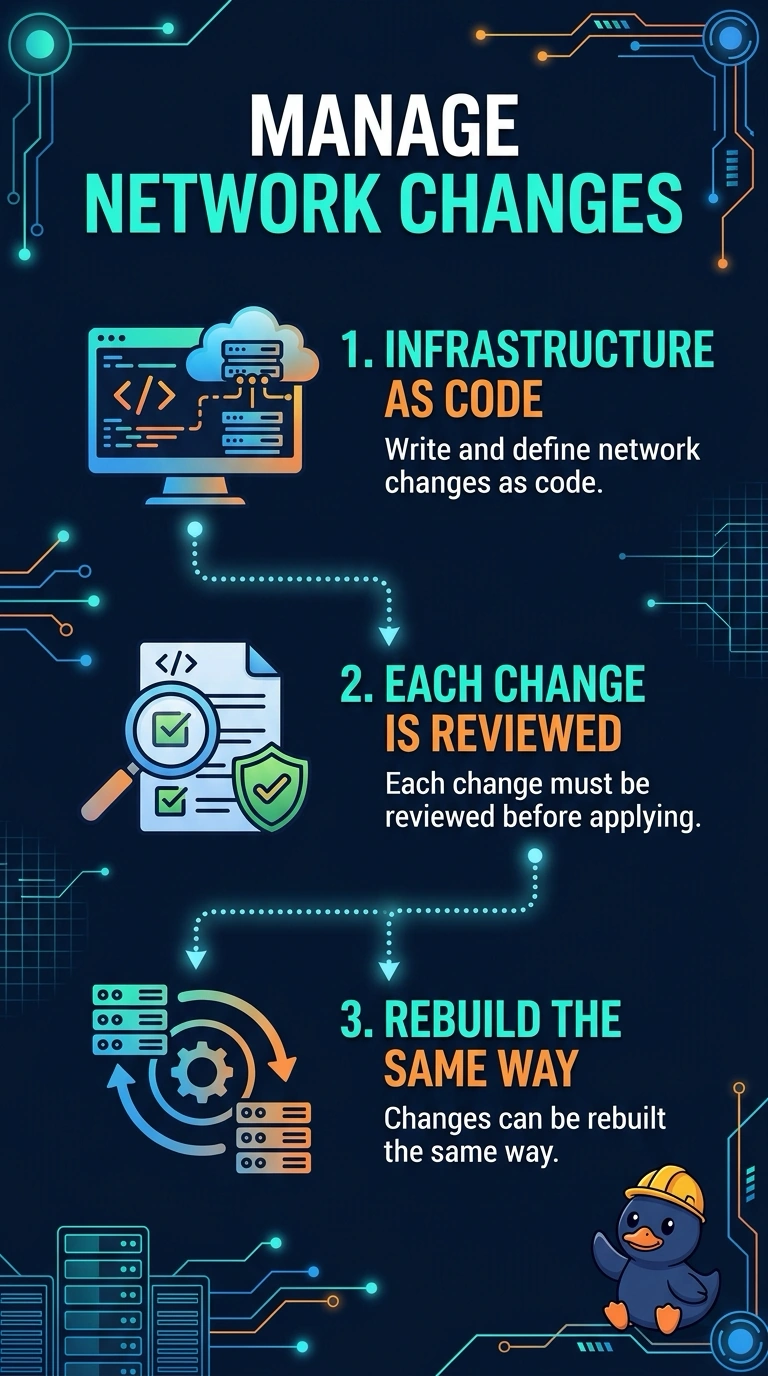
When the only copy of the map is in someone’s memory, you can’t rebuild the road. Put the network rules in infrastructure as code so you can review and apply them again. More monitoring, a container-image scan, or an incident playbook won’t capture a change clicked by hand.
Full Explanation
The credit union already has logs and alerts; what’s missing is a way to review and rebuild network rules that operators currently click by hand. Infrastructure as code stores each rule in a reviewed template and lets you apply that template again after drift. Infrastructure as code so each network change is reviewed and can be rebuilt the same way meets this requirement. Another monitoring agent for network logs the credit union already collects and alerts on is a poor fit: more monitoring watches failures the credit union already alerts on but does not make the next edit reviewable. A container-image scan for a build pipeline that this union does not run is a poor fit because image scanning checks containers, while the gap is hand-edited network rules, not an image build. An incident playbook that runs after an outage and does not record the next console edit is a poor fit because it responds after an incident but does not turn the next console click into reviewed code. Exam caveat: Keeping code in a repository is not enough unless you close the console path; otherwise, operators can still make a change that the reviewed template does not show. Practical check: Apply a lab network rule only from the template, then change it in the console and confirm the next apply returns the rule to the reviewed version.