
A city's open-data API is built from code, its containers are scanned, and uptime is already monitored. Anyone on the internet can download resident service requests. Which element is missing?
Select an answer to reveal the explanation.
Short Explanation
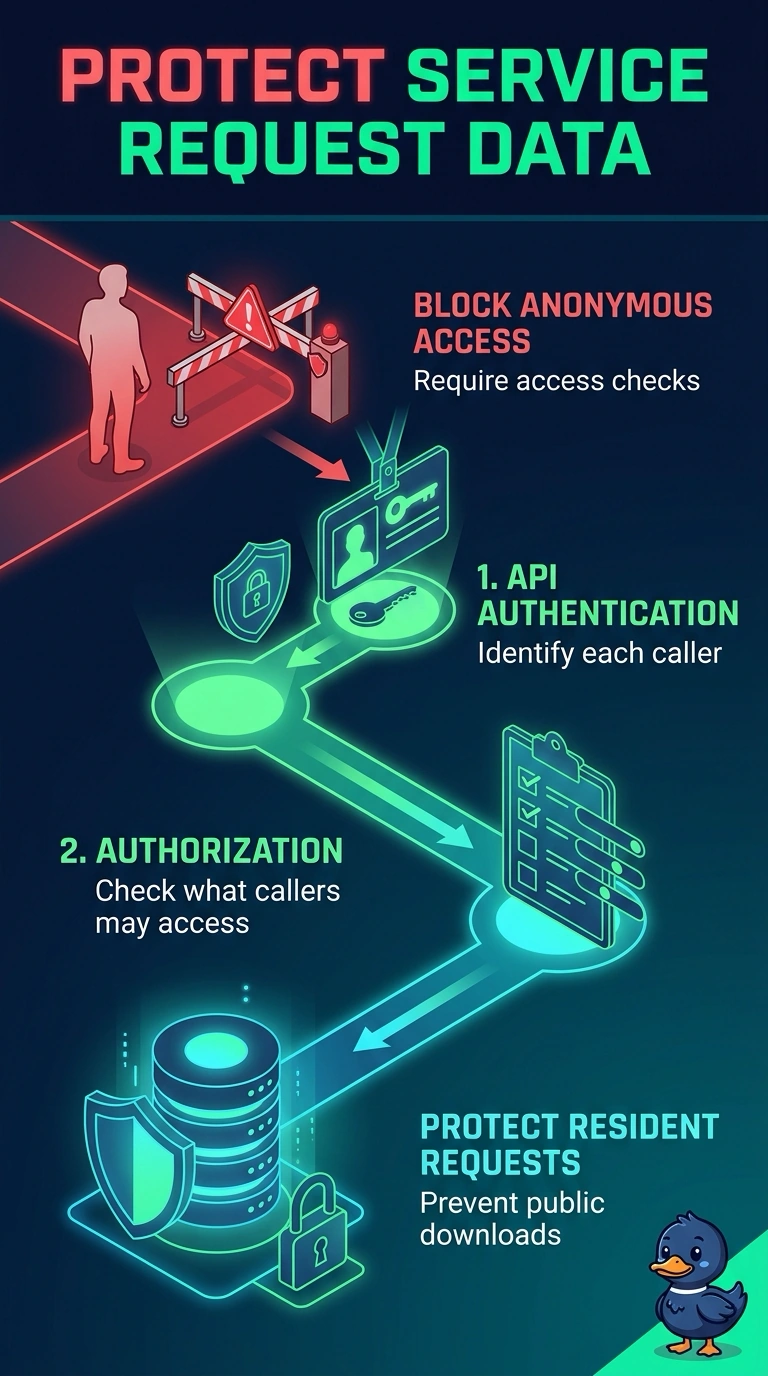
The doors, the cameras, and the fire drill are already in place, and the records shelf has no lock. You add authentication and authorization on the API. Another image scan, a second uptime dashboard, or an outage playbook does not ask who is taking the records.
Full Explanation
The pipeline already has infrastructure as code, image scanning, and uptime monitoring. The missing element is on the API itself: anonymous callers on the internet can pull resident service requests. Authentication and authorization put a check on that call: Authenticate the caller and check that it is authorized for the requested resident records before returning them. Another scan, another dashboard, and an outage playbook improve work the city already does and never ask who the caller is. API authentication and authorization so anonymous callers cannot pull resident service requests is the design that meets this requirement. Another container scan for images the city pipeline already scans on every build is the wrong fit because the images are already scanned on every build, and another scan does not require a caller to authenticate. A second uptime dashboard for a service whose availability is already on a monitor is the wrong fit because uptime is already monitored, and a second dashboard does not stop an anonymous download of resident requests. An outage playbook for failures the city can already see on the existing uptime monitor is the wrong fit because an outage playbook reacts to availability events the city can already see, and the hole is an open API. Exam caveat: Authentication is the missing element only because the scenario already has the build, the scan, and the monitor. Do not spend this answer on a control the city already listed. Operational check: Call the resident-request API with no credential and confirm it is denied, then call it with an authorized test client and confirm a scoped response returns.