
An attacker who already sits on a factory historian pivots to a neighboring controller. The hop stays inside the segment and does not cross the perimeter firewall. Which control can see and constrain that pivot?
Select an answer to reveal the explanation.
Short Explanation
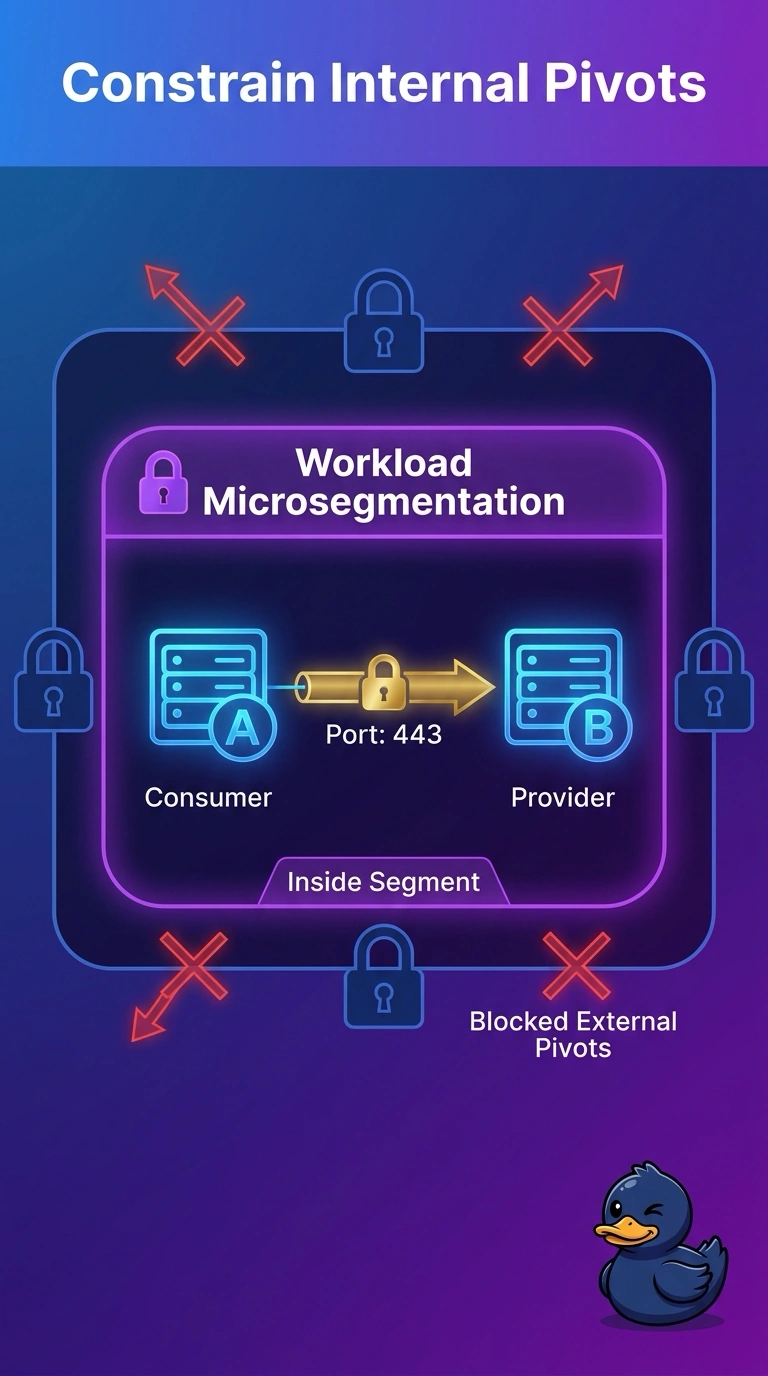
A guard at the city line does not see a dispute that stays inside one building. This pivot does not cross the perimeter, so perimeter intrusion prevention does not observe it. You constrain that inside hop with workload microsegmentation that names who may talk, and on which port.
Full Explanation
A pivot from the historian to a neighboring controller that stays inside the segment does not arrive at the perimeter, so a control on that firewall cannot see it or stop it. Workload microsegmentation that names the consumer, the provider, and the port can allow or drop that inside conversation. Perimeter intrusion prevention on the factory firewall inspects traffic that crosses the perimeter. Both hosts staying inside one segment leave that sensor with nothing to judge. A security group that lives only in a public cloud account limits interfaces in that cloud account. It does not follow a pivot between two factory-floor hosts. Encryption at rest protects stored bytes on the historian disk. It does not stop a live lateral connection to the controller. Exam caveat: microsegmentation has to name the real provider and port, or a broad allow inside the segment leaves the same pivot open. Operational check: attempt the historian-to-controller connection after enforcement and confirm the workload policy drops it while the perimeter log stays empty for that hop.