
A clinic keeps its test imaging service and its production imaging service in one Secure Workload inventory scope, and a test deny is now dropping live patient lookups. Test enforcement must remain active. How should the team contain that rule?
Select an answer to reveal the explanation.
Short Explanation
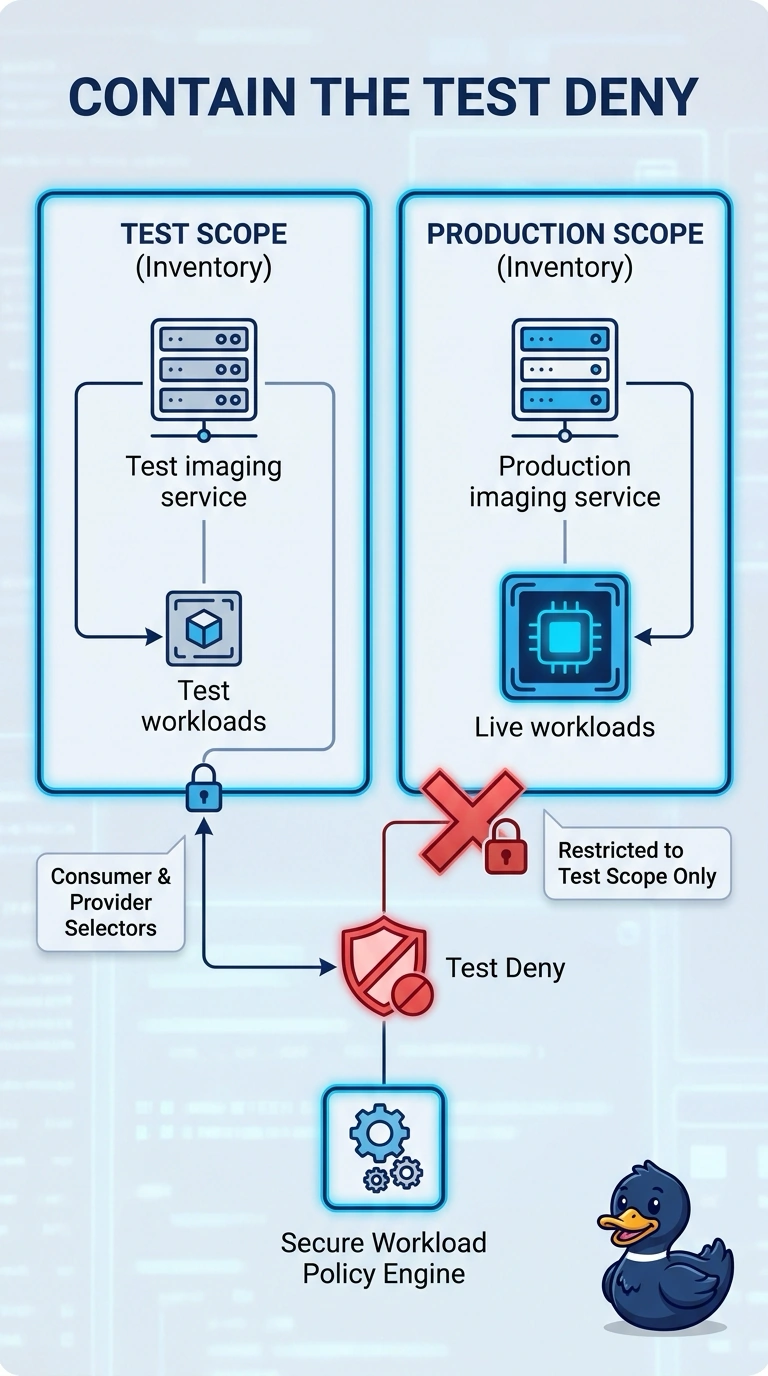
One bin for clean tools and dirty tools means a practice swipe hits the live set. Test and production imaging share one inventory scope, so the test rule is selecting production. You use distinct test and production filters or scopes and restrict the test deny's selectors to the test inventory, so a practice rule cannot name the patient-facing workloads.
Full Explanation
An inventory scope is the set of workloads a rule can select. While test and production imaging share one scope, a test deny can select the live service and drop patient lookups. Use distinct test and production inventory filters or scopes and restrict the test deny's consumer and provider selectors to the test inventory, so the test rule cannot select live workloads. Leaving both services in the shared scope and switching it to monitoring mode only records the test deny. The rule still names the live workloads and will drop them again if that scope is later enforced. Adding the production imaging service as an explicit consumer on the test rule pulls production further into the test policy. It does not confine the deny to a test label. Turning off flow collection on the shared scope hides the drops from the operators and leaves the test rule in place. Exam caveat: two names inside one scope are still one policy target until the selectors are actually restricted. Verify both matched endpoint sets in policy analysis before enforcing the test rule. Operational check: after the split, apply a test deny and confirm production imaging lookups still succeed while the test service shows the deny.