
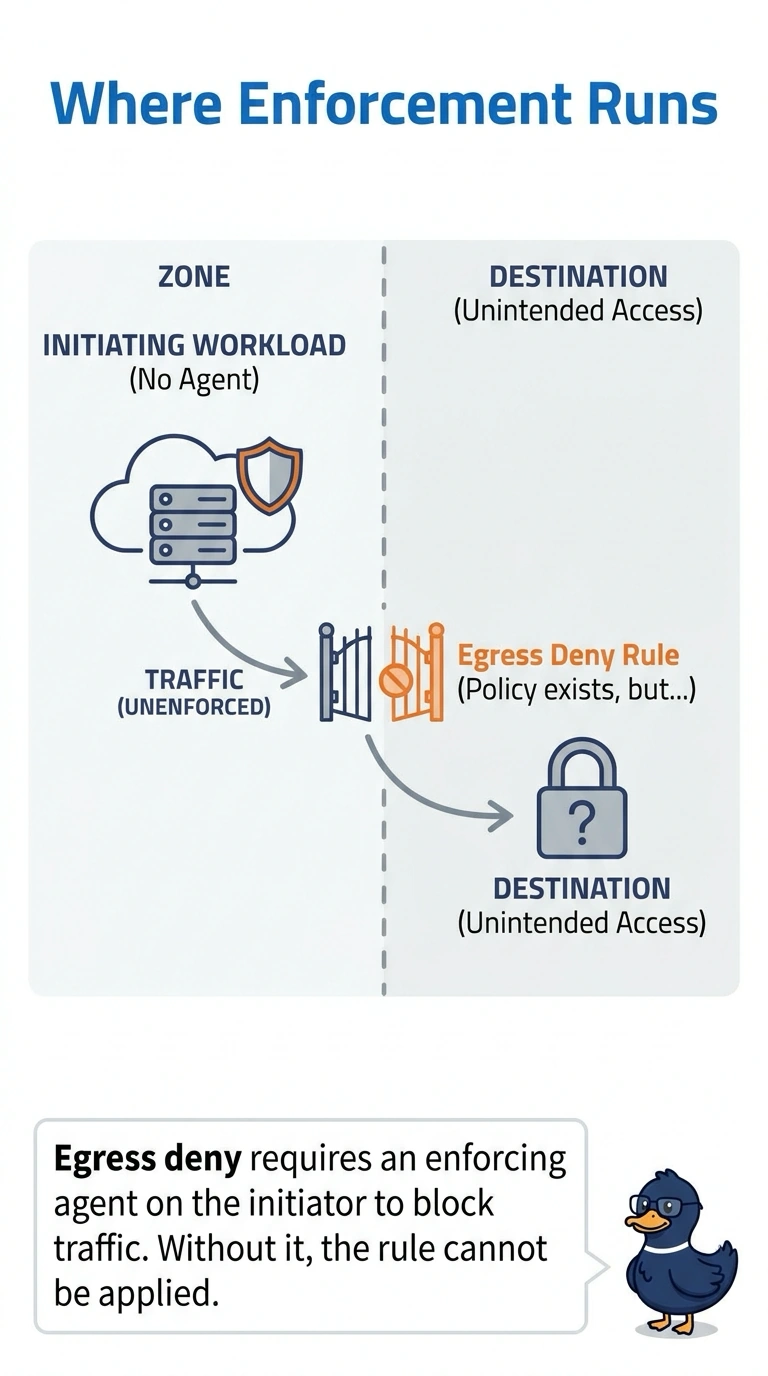
A school places a Secure Workload label on one virtual machine. The process that opens the connection runs on a different workload where no agent is installed, and the intended deny never fires. The deny is configured only for egress on the initiating workload. Why does that deny fail?
Select an answer to reveal the explanation.
Short Explanation
A camera over the lobby does not stop someone leaving through a side door it cannot see. You enforce on the workload that starts the flow, and a label on a different machine does not cover a host with no agent. The trap is expecting a nearby label to police a process elsewhere.
Full Explanation
Secure Workload enforcement sits with the agent on the workload. The process that opens this connection runs where no agent is installed, so the egress rule has no enforcing agent on the initiating workload to apply it and cannot fire. An enforcing agent on the destination can also enforce a matching ingress policy. A label on any virtual machine does not cover every process running in the cluster. The labeled machine is not the one starting the socket. Perimeter intrusion prevention watches a perimeter. It does not already see that internal connection and drop it when the traffic stays off the perimeter, and the missing agent is why this deny fails. DNS security blocks names at a resolver. It does not block the new connection because a name policy covers process starts, and a process start is not a DNS query. Exam caveat: an internal pivot that stays inside the segment is invisible to perimeter intrusion prevention. Operational check: install or repair the agent on the workload that actually opens the socket, confirm the process shows up in discovery, and then verify the intended deny increments on that agent.