
A hotel chain requires both internet-bound branch traffic and private-application traffic from each property to be enforced by cloud policy. Which steering method carries both kinds of traffic?
Select an answer to reveal the explanation.
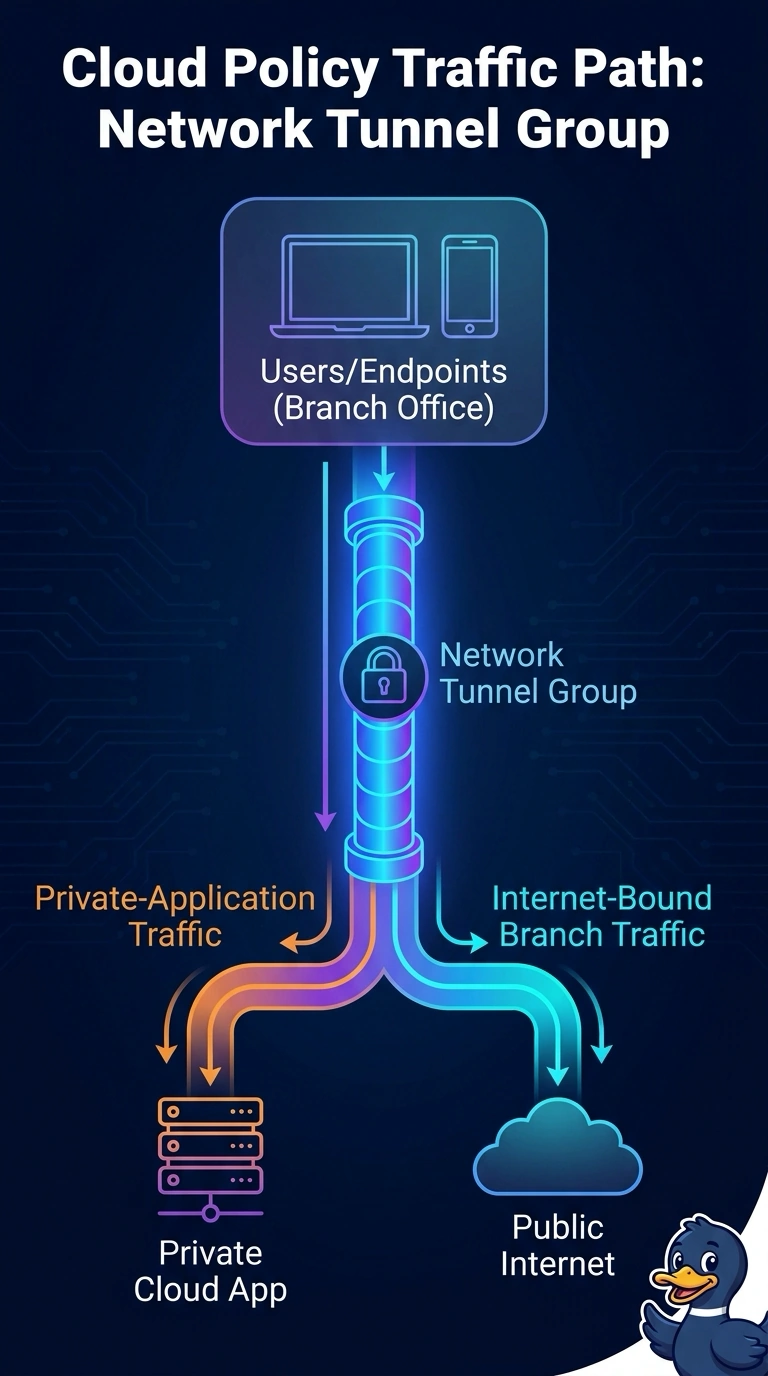
Short Explanation
You need both kinds of traffic to reach cloud policy, so a network tunnel group carries the internet-bound and private-application traffic together. A resource connector handles private access, while direct breakout and path selection do not provide the required cloud-policy enforcement.
Full Explanation
A network tunnel group is the steering method that carries both private-application traffic and internet-bound branch traffic, so it fits the requirement to enforce both kinds of traffic through cloud policy. A resource connector provides access to the private resources you specify by making outbound connections for that private access; it does not carry a property's general internet-bound branch traffic. Direct internet breakout with a local allow-all sends traffic out from the property rather than through the cloud-policy path, so the claim that it still reaches the same cloud policy is incorrect; it also does not meet a fail-closed requirement. Path selection on the property edge chooses which circuit traffic uses, such as the faster circuit, but that choice is not an allow-or-block decision for users or applications and does not itself enforce cloud policy. Exam caveat: if a connector group and a tunnel both serve the same private resource, the connector is preferred for that resource; that preference does not make the connector a replacement for a tunnel carrying internet-bound traffic. Practical check: from a property, generate one internet-bound flow and one private-application flow, then confirm that both appear in logs for the cloud policy reached through the network tunnel group.