
Two imaging servers at a hospital sit on one VLAN and talk to each other on every port, and the gateway access list never records those conversations. Which control can limit them to the application port?
Select an answer to reveal the explanation.
Short Explanation
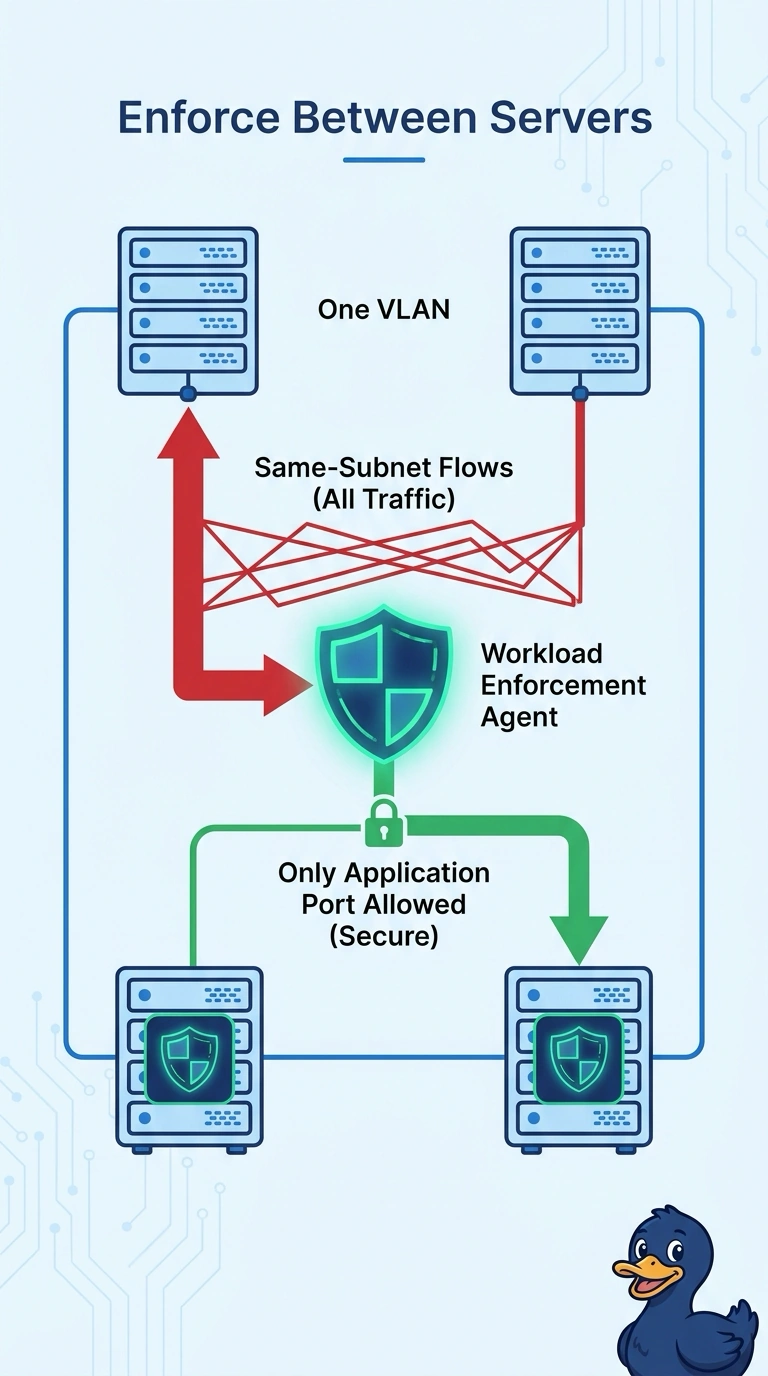
Two people whispering in the same room are invisible to the guard at the front gate. You use a workload enforcement agent that sees those same-subnet flows and limits the servers to the application port. A gateway access list does not record the conversation you are trying to constrain.
Full Explanation
Workload agents see flows, including same-subnet flows a gateway access list never sees, and they can limit a consumer and a provider to a port. The imaging servers talk on every port inside one VLAN, so a workload enforcement agent that sees those same-subnet flows and allows only the application port is the control that can constrain them. Tightening the gateway access list cannot, because those frames never arrive at the gateway to be inspected. Moving both imaging servers to a new subnet and keeping an any-to-any rule changes the addressing and still permits every port, so it is not the same thing as limiting them to the application port. Perimeter intrusion prevention does not see an internal conversation that stays inside the segment, so relying on it leaves the every-port path in place. Exam caveat: discover the real application port before you enforce, or a deny that is too tight cuts a dependency the imaging system still uses. Operational check: record the flow between the two servers, confirm it is invisible on the gateway access list, and confirm the workload policy allows only the application port.