
A school district runs Meraki at the elementary sites and Catalyst SD-WAN at the high schools, and each vendor team has started writing its own allow and block rules. How should access policy be applied to both kinds of sites?
Select an answer to reveal the explanation.
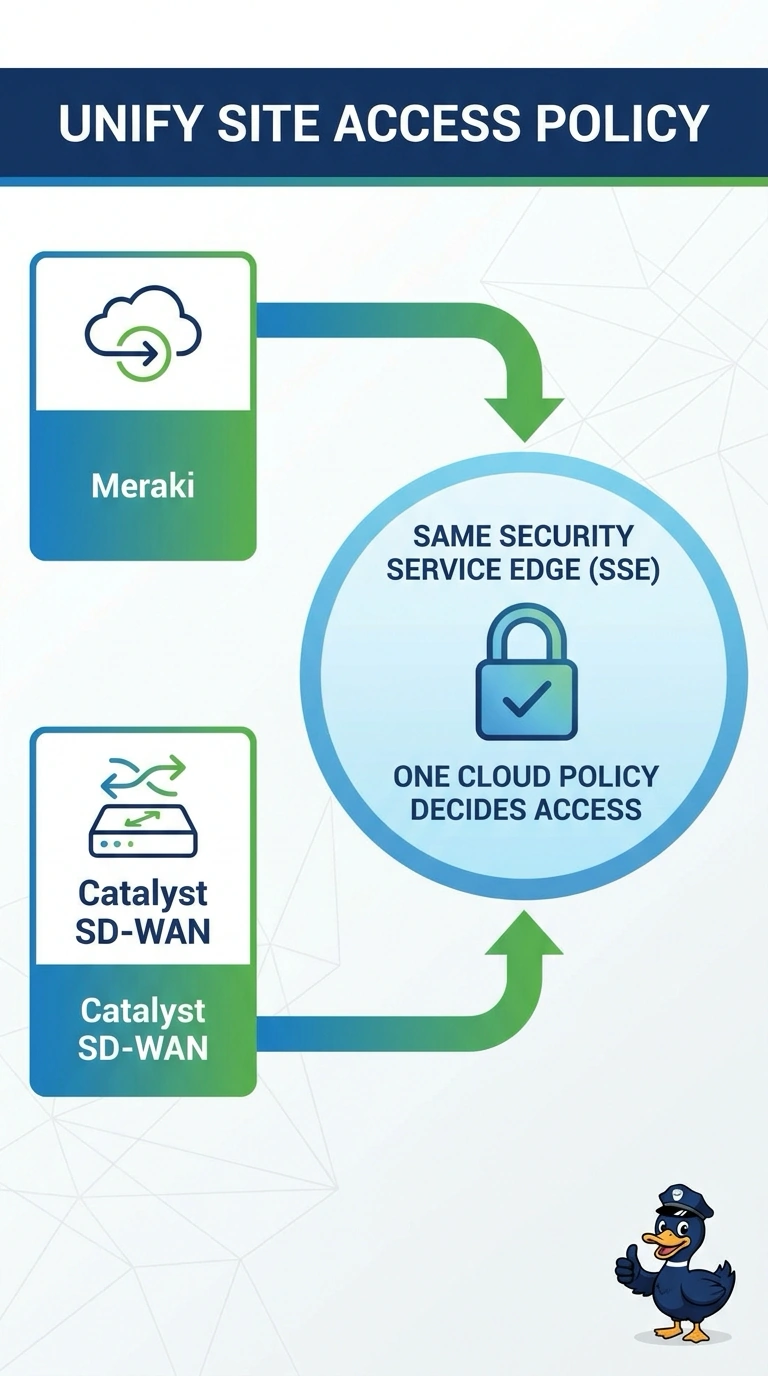
Short Explanation
Two school kitchens can follow one menu instead of each cook inventing a different set of rules. You steer the Meraki sites and the Catalyst sites into the same security service edge so one cloud policy decides access. A local copy of the rules on each vendor, or treating path selection as the decision, is the trap.
Full Explanation
Cisco Secure Access is the security service edge that applies identity, destination, and application policy once branch traffic is steered there. Meraki and Catalyst SD-WAN are both valid ways to steer, and they can still enforce locally for flows that never enter the edge. The district should steer the Meraki sites and the Catalyst sites into the same security service edge so one cloud policy decides access, instead of letting each vendor team drift. Keeping a separate security intent on each edge recreates the same rules in two places, and those copies will not stay aligned. Replacing both edge platforms with one firewall brand is an unnecessary platform swap. Steering does not require the edges to be the same product. Treating path selection on each edge router as the allow or block decision confuses choosing a circuit with deciding whether the user and the application are allowed. Exam caveat: a site that breaks out to the internet directly never hits that shared cloud policy, so steering has to be real before the single policy can matter. Operational check: compare an elementary site and a high school in the same policy report and confirm both are evaluated by the cloud rules rather than by a local copy unique to that vendor.