
Two application servers in a bank data center exchange records on the same segment, and that traffic never enters Cisco Secure Access. A local host firewall or transparent firewall sees this server-to-server traffic. Which control can govern that east-west flow?
Select an answer to reveal the explanation.
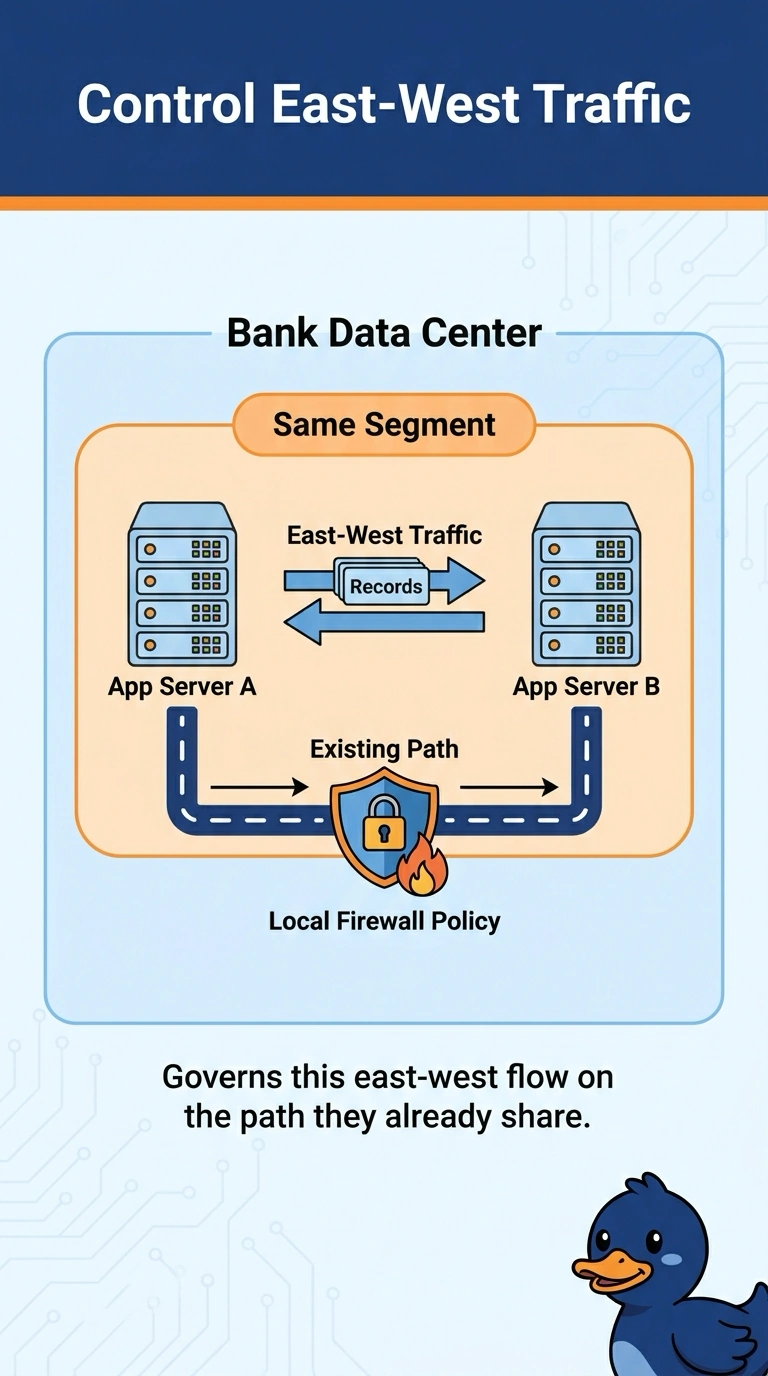
Short Explanation
Two clerks handing a folder across one desk do not stand in the lobby line, so the lobby rules do not see that handoff. You govern this east-west exchange with a local firewall policy on the path those servers already use. The trap is expecting a cloud user-web rule to police traffic that never enters Secure Access.
Full Explanation
Traffic between two servers on the same data-center segment that never enters Cisco Secure Access is outside every cloud user-web rule. A local firewall policy on the data-center path those two servers already use is the control that can see and govern that east-west exchange. The cloud user-web rule in Secure Access that lists the bank's approved internet categories matches users and destinations only after traffic is steered to the edge, which this hop is not. A guest wireless category block that applies only after bank browsing is steered into the edge is a different population and a different path. WAN path selection that chooses which circuit a bank branch uses when it leaves the building picks a route. It is not an allow or block for a server-to-server flow that stays inside the data center. Exam caveat: path selection and a cloud rule that the packets never reach are both the wrong tool when the flow is purely east-west. Operational check: trace one records exchange between the two servers and confirm it is permitted or denied on the local firewall, not in the Secure Access activity log.