
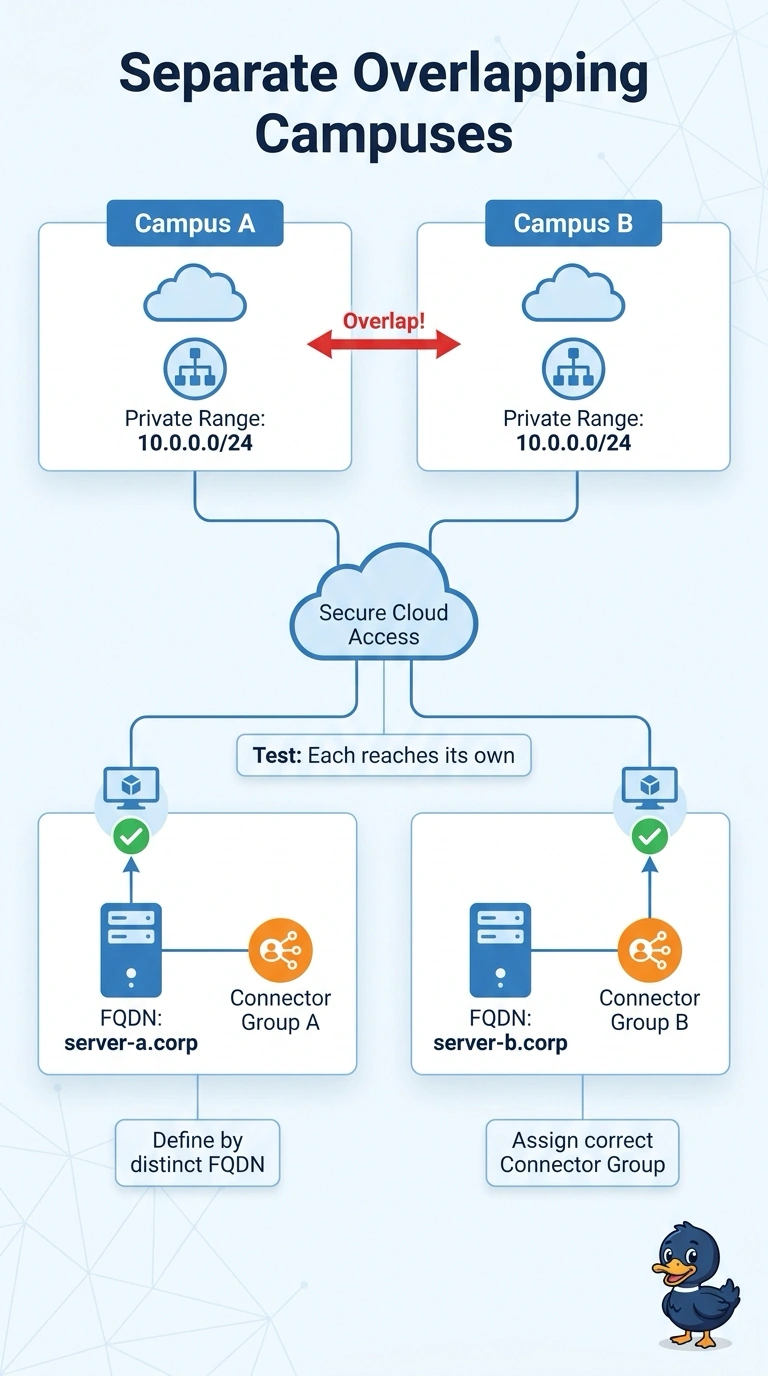
A university has absorbed two campuses that reuse the same private address range, and Secure Access must tell their records systems apart. The two systems have distinct FQDNs and each is reachable through its campus's resource connector group. What should the application policy do?
Select an answer to reveal the explanation.
Short Explanation
Two campuses that share a street number are separated by the office name, not by paving the same road twice. You define each private resource by its distinct FQDN and assign the correct resource connector group. The trap is routing that identical subnet into two tunnels and expecting the routes to tell the flows apart.
Full Explanation
When two acquired campuses reuse one private address range, the policy tells the systems apart by what each resource is, not by routing the shared subnet twice. Define each private resource by its distinct FQDN and assign the correct resource connector group, so each records system matches as itself and reaches its own campus. Routing the identical subnet into two tunnels does not help, because both paths still carry the same range and the policy cannot see a difference. Putting both campuses on one guest internet rule merges populations that should be distinct. Sending both campuses straight to the internet keeps the private application policy off the path, so the rule you are trying to write never sees the traffic. Exam caveat: overlapping addresses are solved by distinct resource definitions tied to the right connector group. A second route for the same subnet does not create a second identity. Operational check: define each records system by its FQDN in Secure Access, assign its connector group, and confirm a test from each campus reaches only its own system.