
A bank Catalyst SD-WAN edge selects a low-latency underlay for a branch user who then reaches a site the security policy is supposed to block. Which statement is correct?
Select an answer to reveal the explanation.
Short Explanation
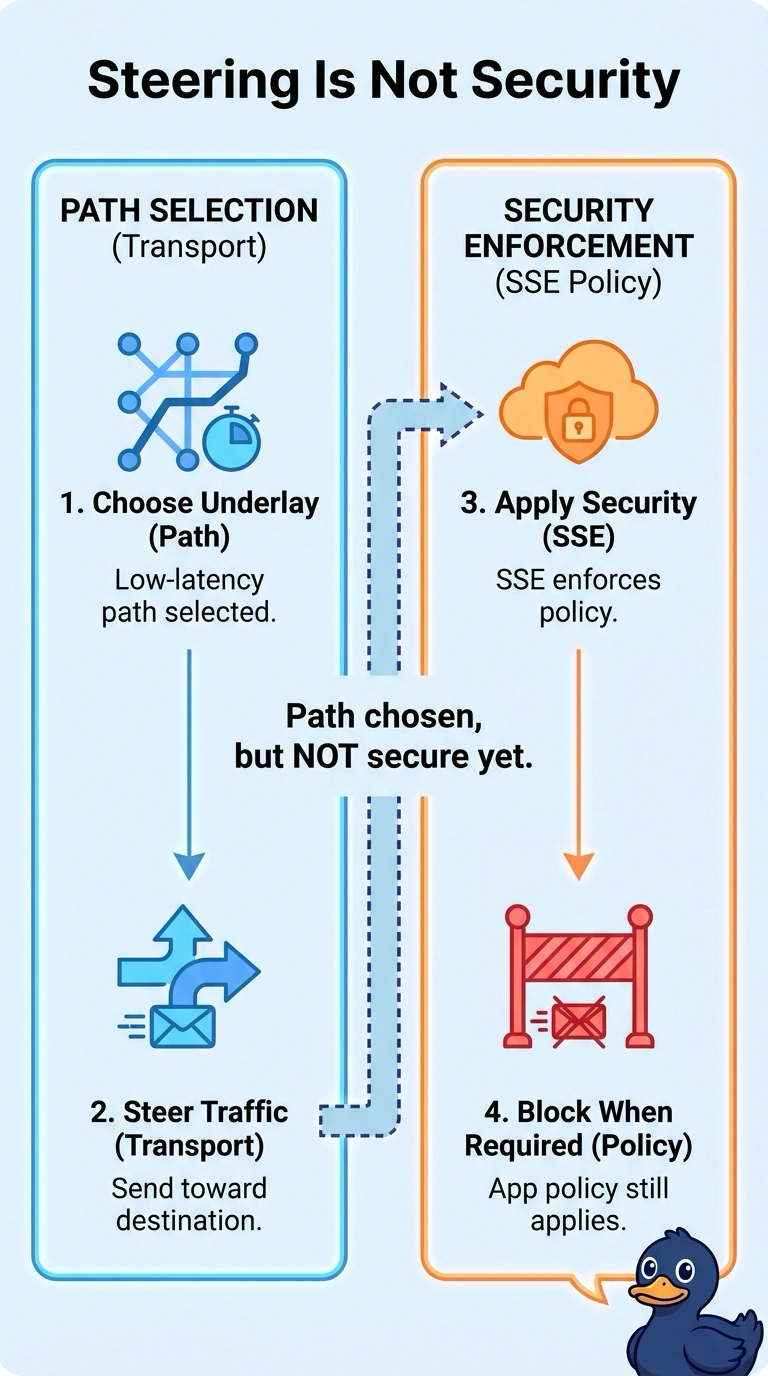
Picking the faster highway does not decide whether the vault guard lets you in. You still enforce application policy at the security service edge after the traffic is steered, because a low-latency underlay is only a path. The trap is treating that path choice as the allow or the block.
Full Explanation
Catalyst SD-WAN can select a low-latency underlay, and that path selection is not the allow or block. Once the flow is steered, application policy is still enforced at the security service edge after steering. Treating the low-latency underlay choice as itself the allow or block leaves the security service edge with a decision it still has to make. Local path selection replaces nothing about application policy, and a flow that has been steered is judged by that policy rather than skipped. A direct internet breakout is how traffic avoids the security service edge, so requiring that breakout before policy can see the flow reverses the steering model. Exam caveat: a branch that breaks out to the internet directly never hits the cloud policy, which is a different failure from a steered flow on a fast underlay. Operational check: steer a test browse to a blocked site over the preferred underlay and confirm the security service edge log shows the block after the path was selected. Underlay choice and policy enforcement stay separate even on the fast path.