
A school requires web access to fail closed when the security service edge tunnel is down, but the branch allows all internet traffic locally if that tunnel drops. Why does that local breakout fail the requirement?
Select an answer to reveal the explanation.
Short Explanation
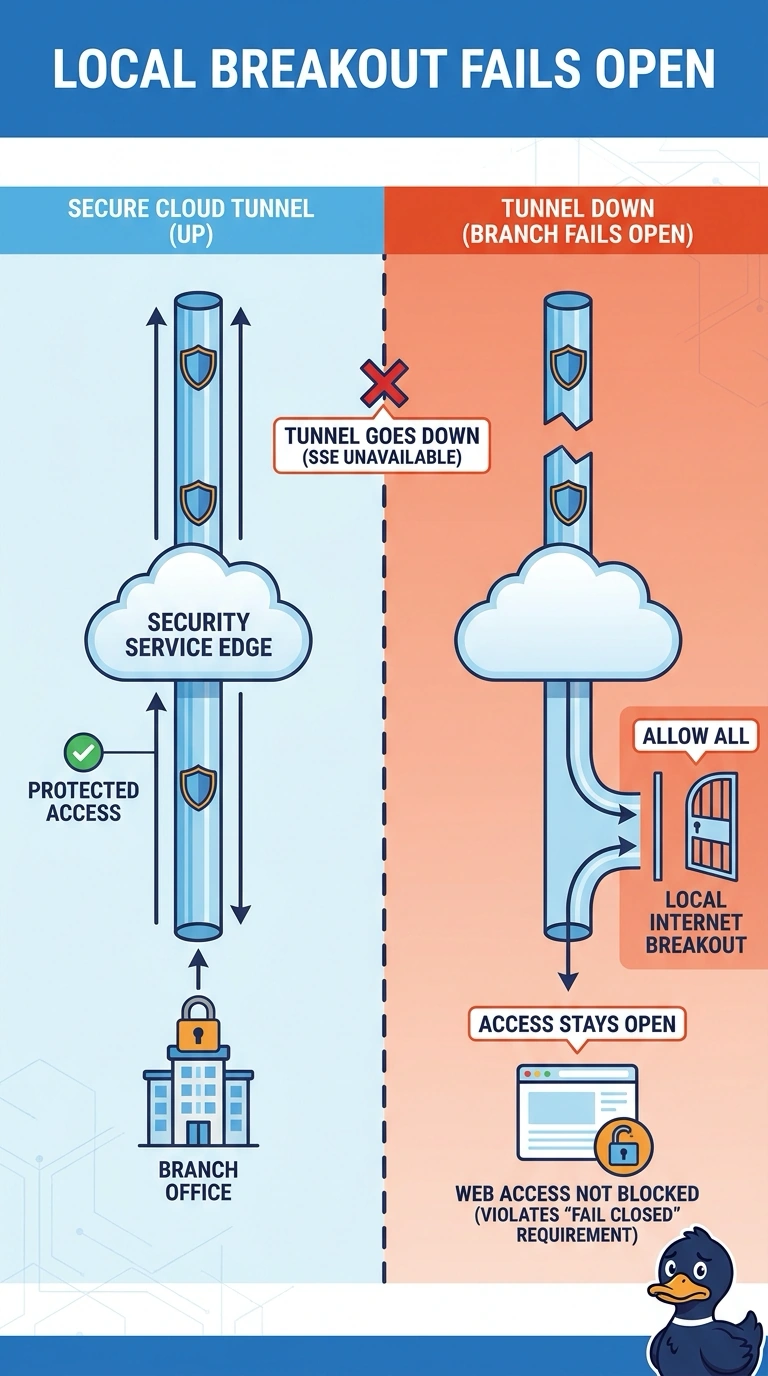
Fail closed is a gate that stays shut, and an open side door is the opposite of shut. You reject the local allow-all escape because it keeps internet access open when the tunnel is down. The trap is redefining fail closed as pass everything, or calling a second road a security policy.
Full Explanation
The stated requirement is to fail closed when the security service edge tunnel is down. A local allow-all escape leaves internet access open, so the branch fails open instead of failing closed and the requirement is missed. Passing every web request with inspection off until the tunnel returns is an open path, not a fail-closed one. Moving traffic to a second underlay is path selection, and it is not the same control as a fail-closed policy at the security service edge. A resource connector exposes private applications and does not already enforce the web policy that the allow-all is bypassing. Exam caveat: one cloud policy only helps traffic that is steered into the edge, and a local allow-all is an escape from that policy. Operational check: drop the tunnel in a maintenance window and confirm branch web access stops, rather than breaking out to the internet with everything allowed. During that outage, users should lose general web access until the tunnel returns and policy can see them again.