
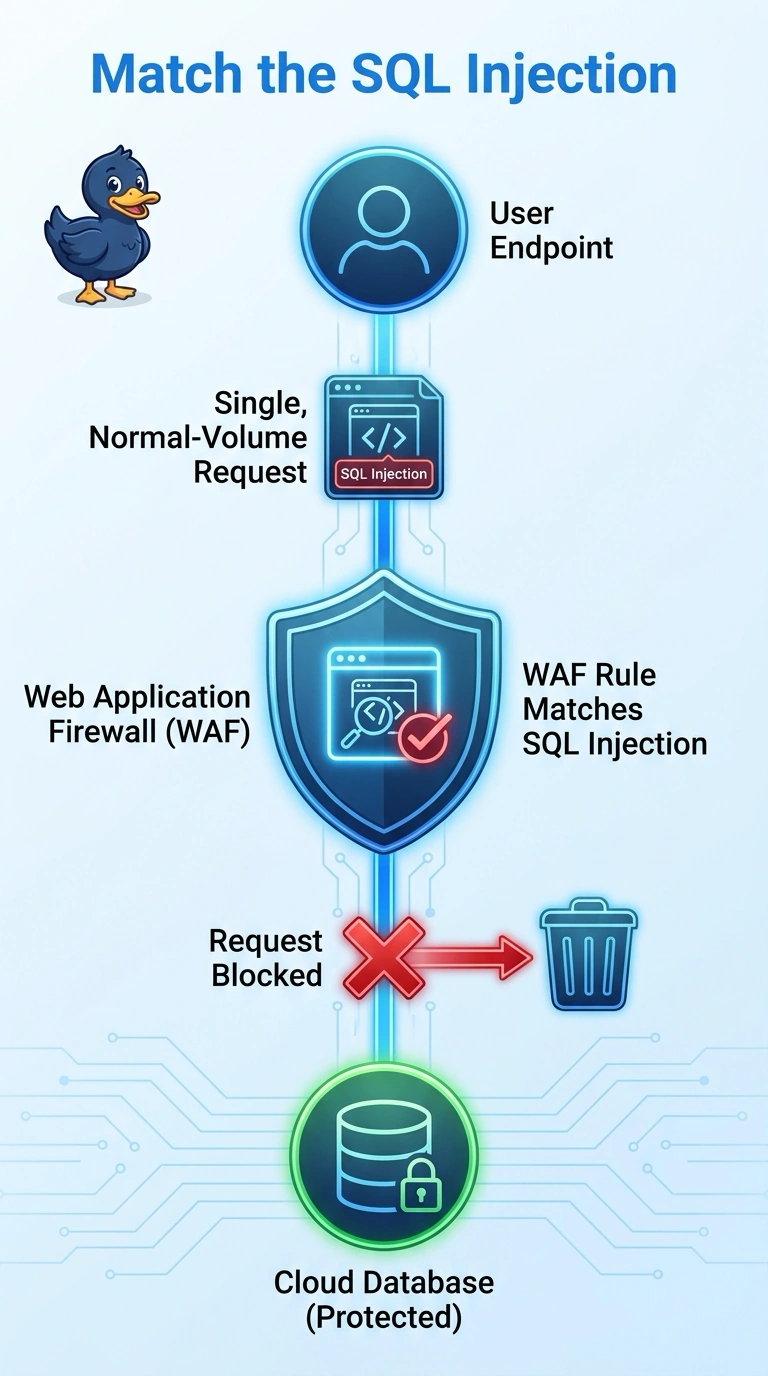
A school's public website receives a single normal-volume request that contains a SQL injection. Which control is suited to that request?
Select an answer to reveal the explanation.
Short Explanation
A metal detector that finds one dangerous item is a different desk from the crew that handles a flood. You match this SQL injection with a web application firewall rule on a normal-volume request. The trap is a DDoS scrubbing profile, encryption at rest, or a DNS block of the site name.
Full Explanation
A web application firewall inspects HTTP and can match attack patterns such as SQL injection inside a request that is otherwise normal in size and rate. Using a web application firewall rule that matches the SQL injection carried in this single normal-volume request stops that request without declaring a flood. Applying a DDoS scrubbing profile treats the event as a volumetric flood. Scrubbing is for traffic that overwhelms capacity, not for one malicious request hidden in ordinary volume. Encrypting the school site's disk at rest protects stored bytes if the disk is stolen. It does not inspect a live HTTP body, so the injected query still reaches the application. Blocking the site name in DNS prevents clients from resolving the school site at all. That is an outage for every visitor, and it does not distinguish the one malicious request from a legitimate page view. Exam caveat: if the same afternoon also brings a packet flood, scrubbing can still be added for that flood, but it does not replace the injection rule. Operational check: replay a benign page request and a request that carries the injection pattern, and confirm only the injection is blocked by the web application firewall rule.