
A factory customer portal passes TLS straight through to the origin, and an HTTP attack is riding inside that encrypted session. What must change before the web application firewall can judge the request?
Select an answer to reveal the explanation.
Short Explanation
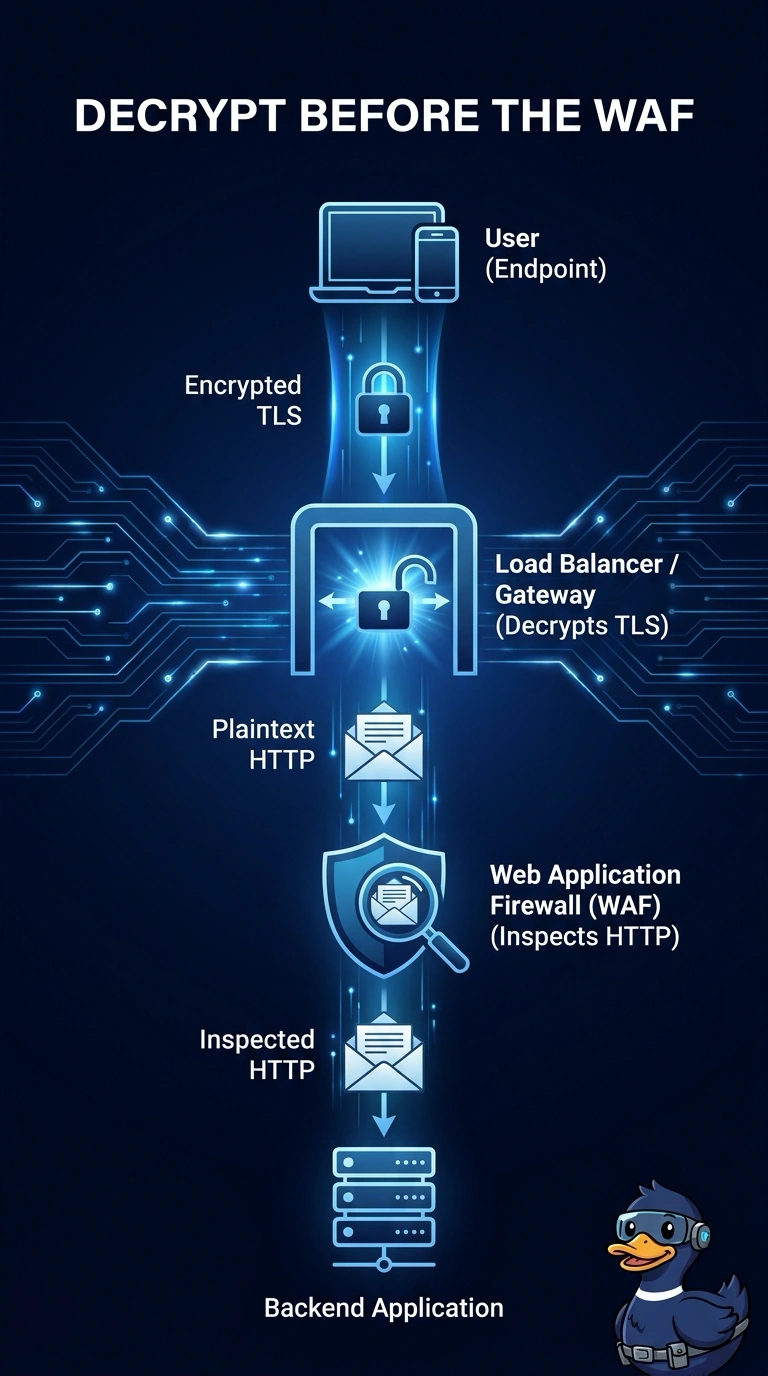
You cannot inspect a sealed crate by reading the label on the outside. You terminate or decrypt TLS at a point that delivers plaintext HTTP to the web application firewall, because a pass-through never shows the attack. The trap is treating this as a pipe-filling flood, a name block, or a lock on data that is already stored.
Full Explanation
A web application firewall sees HTTP, and it cannot judge a request that stays inside a TLS session passed straight through to the origin. The required change is to terminate or decrypt TLS at a point that delivers plaintext HTTP to the web application firewall for inspection, so it can apply the application rules to the request hidden inside the pass-through. A volumetric scrubber in front of the pipe is the control for a network flood that fills the link before a clean HTTP request is formed, and that is not the attack described here. Blocking the portal name in DNS stops a lookup for that name and does not reveal the URL path hidden inside an encrypted session. Encryption at rest protects stored bytes in the portal database and does not classify a live HTTP attack while the session is in flight. Exam caveat: passing TCP 443 through without inspection does not reveal the request, no matter how strict the firewall policy looks on paper. Operational check: send a known bad HTTP request through the portal and confirm the firewall log shows the request path and a block, rather than only an opaque TLS flow.