
A university registration site is being exhausted by clients that hold HTTP connections open very slowly and send little data. Which control addresses that pattern?
Select an answer to reveal the explanation.
Short Explanation
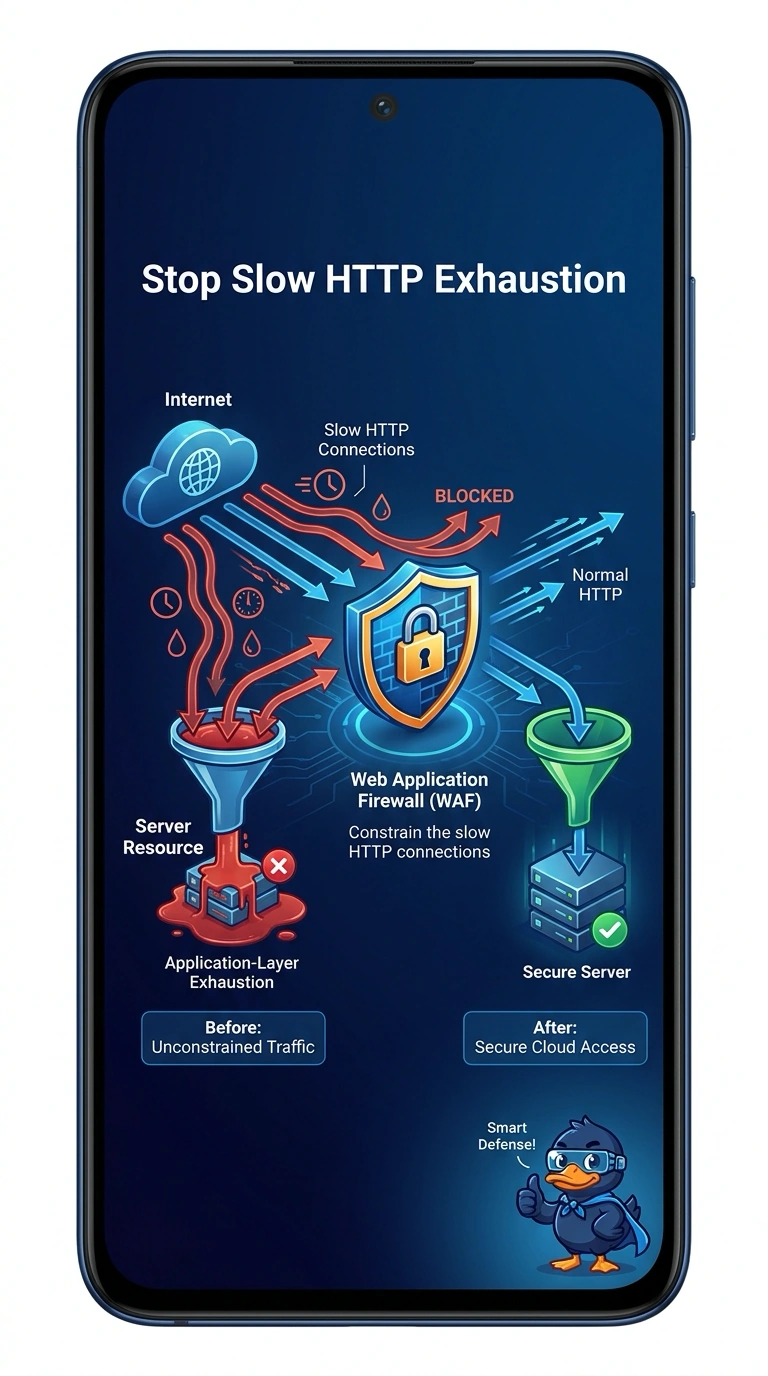
People who hold a door open an inch at a time can fill a lobby without ever sprinting. You constrain those slow HTTP connections with a web application firewall, because the pattern is application-layer exhaustion. The trap is calling it an IPsec problem, handing it to UDP scrubbing, or blocking the public name.
Full Explanation
Slow HTTP exhaustion keeps many application connections open and drip-feeds them so the server runs out of workers while the byte rate stays modest. A web application firewall sees that HTTP pattern and can constrain connection count, header time, or body time. Constraining the slow HTTP connections there matches an application-layer exhaustion pattern. Describing them as an IPsec tunnel problem points at a network tunnel the attack does not require. Rebuilding the campus VPN concentrator does not describe clients holding HTTP sessions on the public registration site. Sending the slow connections to a volumetric UDP scrubbing profile misses the protocol. That profile is built for a high-volume UDP flood, and it never sees the HTTP pattern that defines this attack. Blocking the university's public name at DNS makes the site unresolvable for everyone and leaves the holding connections unexplained. Clients that already have the address continue, and legitimate registration stops. Exam caveat: a true volumetric flood that fills the circuit is still a scrubbing problem, but the modest byte rate here is why the firewall is the fitting control. Operational check: review the firewall's connection and timeout logs during the event and confirm idle or very slow HTTP sessions are limited while a normal registration still completes.