
Someone is sending a model-denial-of-service pattern at a retail bank's own model application interface, and ordinary web browsing is unaffected. Which control addresses that AI-layer abuse?
Select an answer to reveal the explanation.
Short Explanation
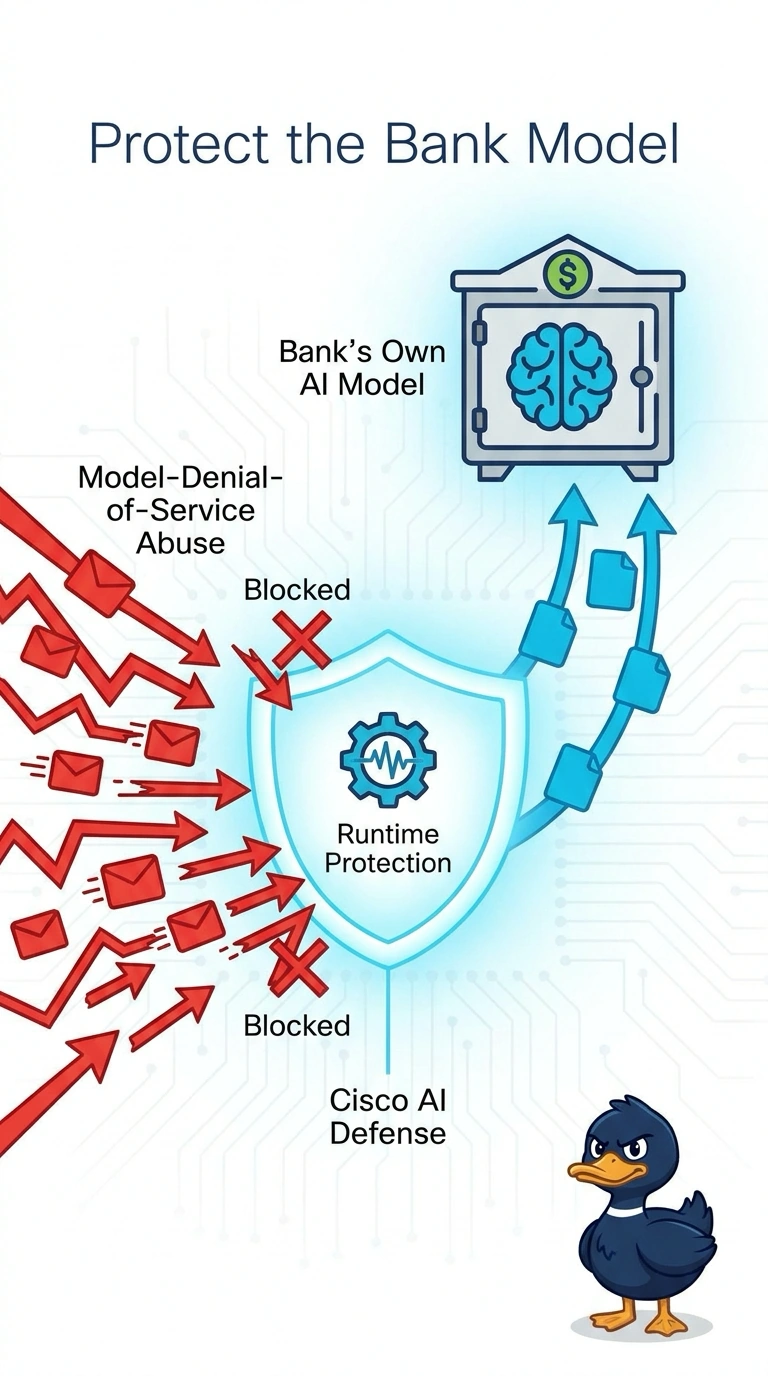
A floodgate on the river does not stop someone from ringing one doorbell until the office cannot think. You use AI Defense runtime protection against the model-denial-of-service pattern on the bank's own model. The trap is a volumetric packet scrubber, which works at a different layer.
Full Explanation
Model denial of service is an AI-layer pattern against the model application, and Cisco AI Defense runtime protection is the control built for that abuse on a model the enterprise runs. Ordinary browsing being unaffected already points away from a filled internet pipe. A volumetric packet scrubber in front of the internet pipe addresses network floods that would also disrupt ordinary browsing, which is a different layer from targeted model abuse. Blocking a public chatbot URL category changes what employees can open in a browser and does not rate-limit or stop requests to the bank's own model interface. Encrypting the model server disks protects stored bytes and leaves the abusive requests untouched. Exam caveat: calling both problems a denial of service does not move a network flood control onto the model, because the layer of the abuse still decides the control. Operational check: reproduce the model-denial pattern in a test window against the bank interface and confirm runtime protection sheds that pattern while a normal prompt still completes.