
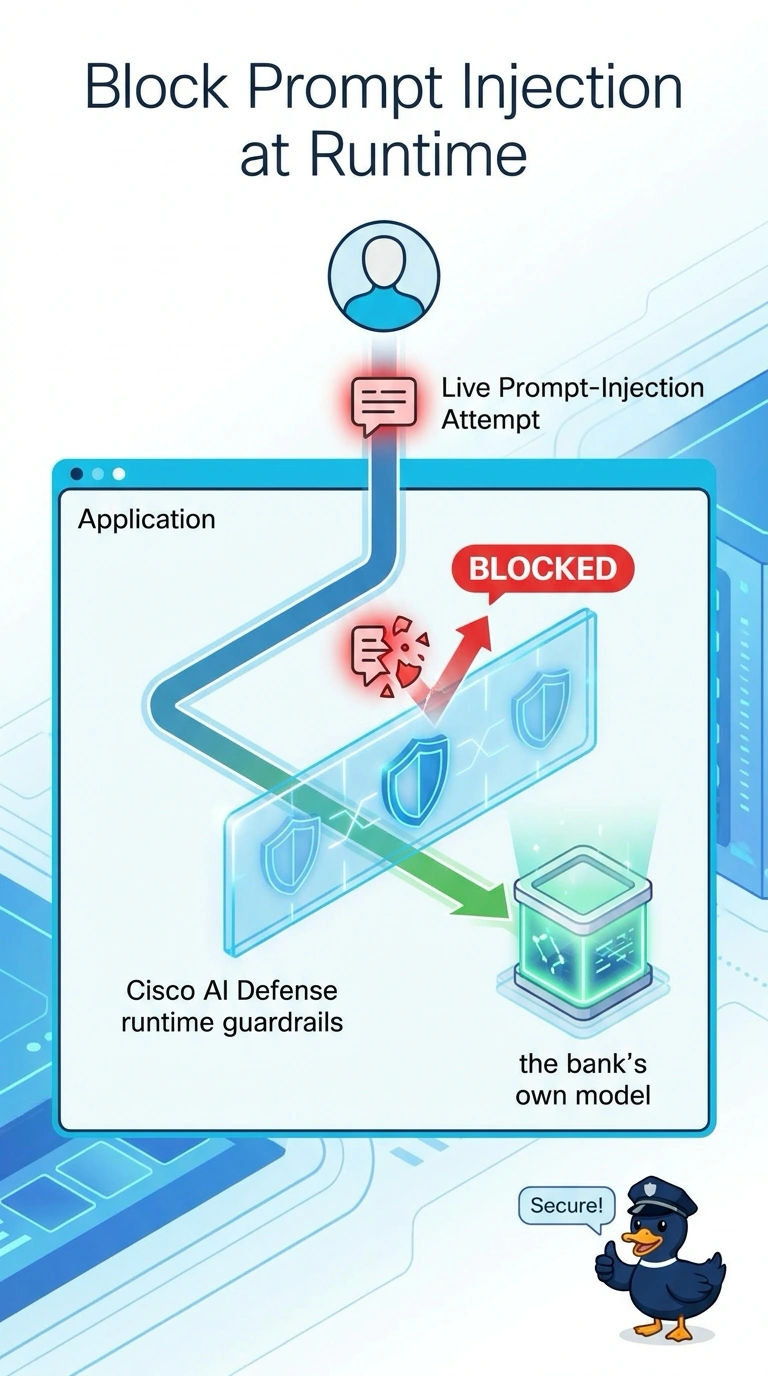
A live prompt-injection attempt is reaching a regional bank's own model through its private application interface. Which control is built to stop that class of attack on this model?
Select an answer to reveal the explanation.
Short Explanation
A bouncer at a public club does not hear an argument inside your private office. You apply AI Defense runtime guardrails so the live prompt-injection attempt against the bank's own model is blocked. The trap is a URL category that does not see that private application interface.
Full Explanation
Cisco AI Defense runtime guardrails are built for attacks against an enterprise model, including prompt injection at the application. Applying those guardrails on the bank's own model blocks this live attempt on the private application interface, which is the path the attack is actually using. A URL category for a public chatbot site only classifies browsing to that consumer destination and does not see the private model interface. A volumetric network scrubber filters packet floods in front of the pipe and does not interpret a prompt sent to the model. A one-time report of consumer AI site names is an inventory of public destinations, not inspection of input arriving at this model. Exam caveat: indirect injection can also ride inside a document the model is asked to read, so runtime inspection has to cover model input and not only a prompt typed by hand. Operational check: send a sanctioned prompt-injection test case at the private interface and confirm the runtime guardrail blocks it while ordinary banking prompts still return.