
A bank enables intrusion prevention and data-loss prevention on a private-access application, but the session is never decrypted. What can those two controls determine about the body?
Select an answer to reveal the explanation.
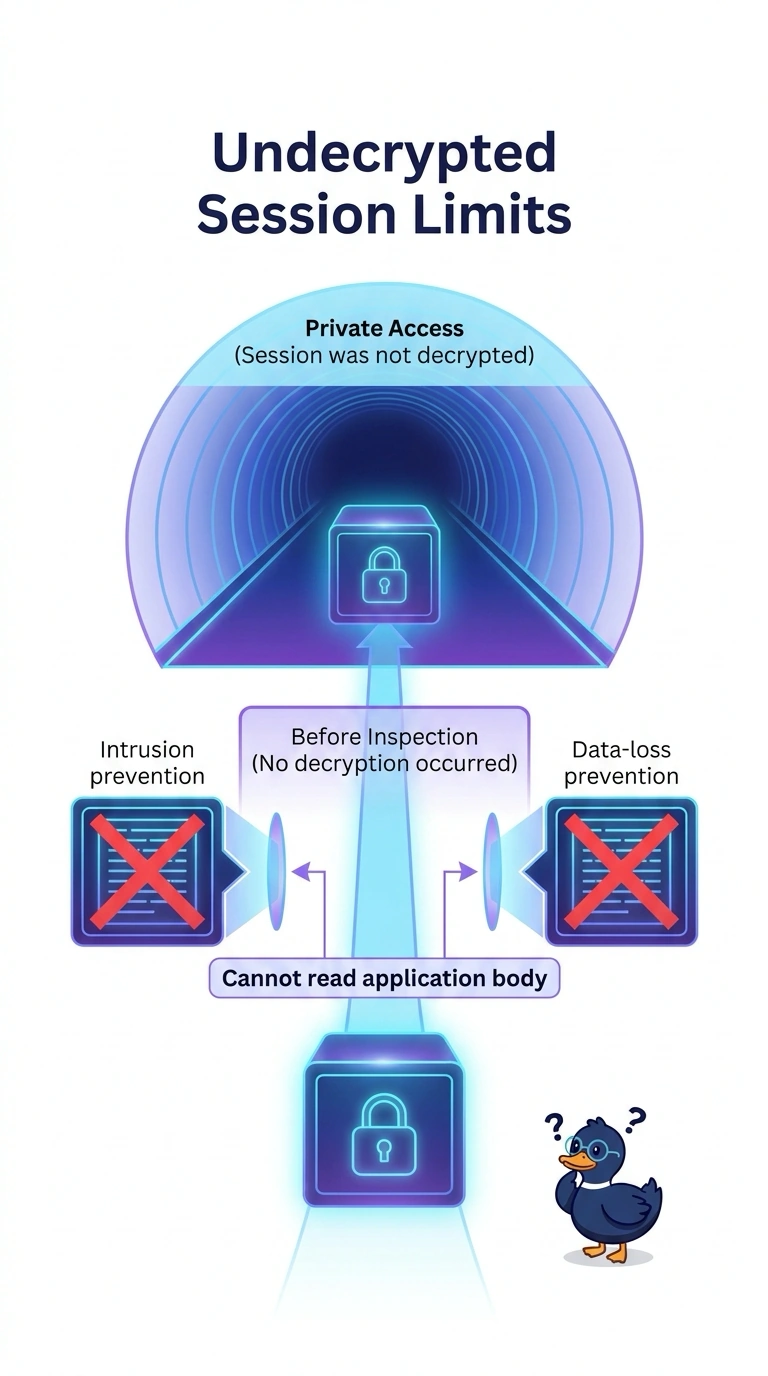
Short Explanation
Think of the encrypted session as a locked suitcase: the controls can inspect what is visible, but the application body stays unread. Because you did not decrypt this private-access session, neither control can read its body, even though both features are enabled. You need decryption before they can inspect the contents.
Full Explanation
Intrusion prevention searches for exploit bytes, while data-loss prevention matches sensitive content; neither can read an application body that remains encrypted. Because this private-access session was not decrypted before inspection, neither control can read its body. Enabling intrusion prevention and data-loss prevention does not make the encrypted body visible, so the claim that both can read the full request and response confuses turning on features with decrypting traffic. Intrusion-prevention signatures cannot identify exploit bytes hidden inside an encrypted session, so enabling only intrusion prevention does not make those bytes readable. Likewise, data-loss-prevention content matching cannot find account numbers hidden in that body; matching rules do not bypass encryption. Exam caveat: allowing a private-access application is not a substitute for decrypting its traffic, and access and inspection are separate decisions. Practical check: verify that decryption is actually occurring for the private-access application before relying on intrusion or content inspection verdicts about its body.