
A lab internal web application receives an exploit over HTTP through the private-access path. Which control on that path can see the exploit?
Select an answer to reveal the explanation.
Short Explanation
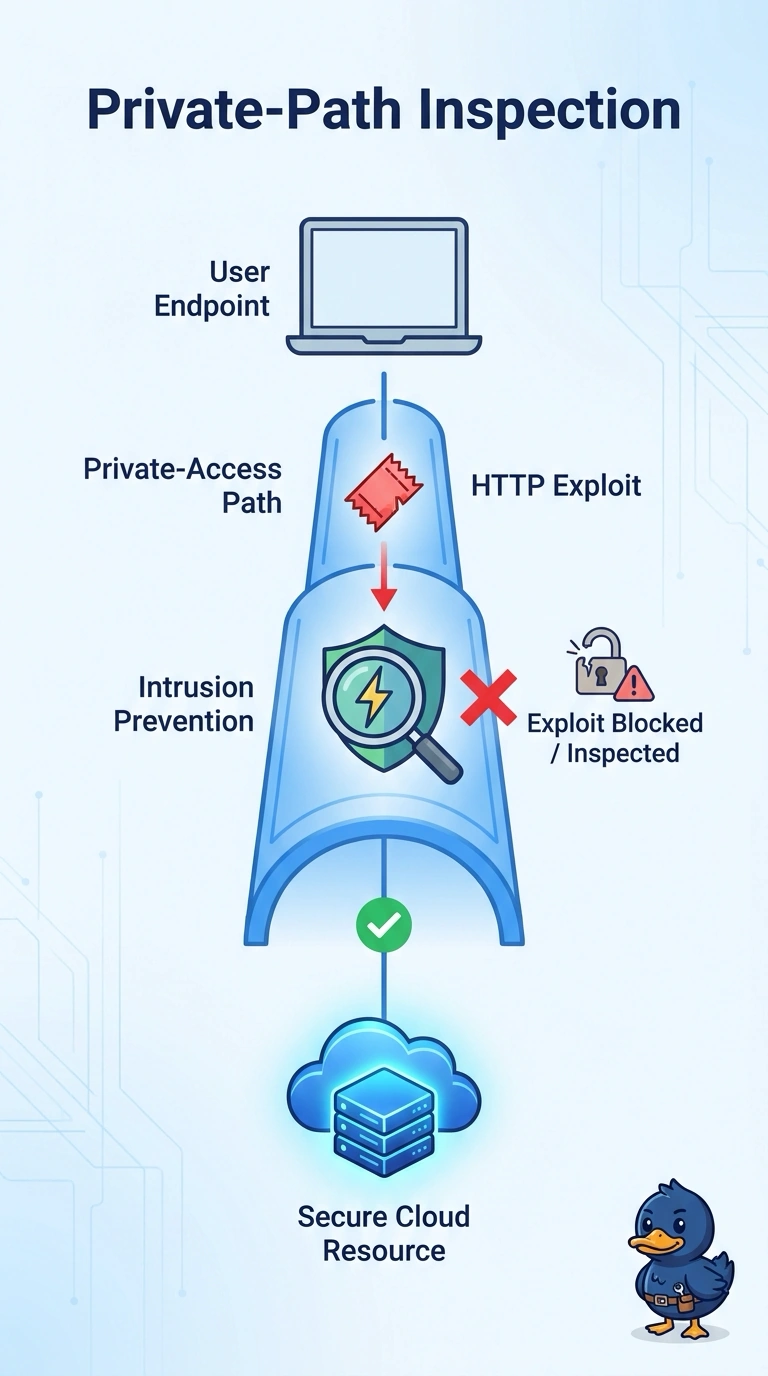
Think of a spell hidden in a letter that was carried down a private hallway, where the street directory never saw the envelope. You use intrusion prevention on that private-access path, because it can inspect the HTTP exploit. The trap is expecting a DNS list, disk encryption, or a category allow to judge the exploit.
Full Explanation
Intrusion prevention looks for the exploit. On a private-access path that carries HTTP to an internal web application, intrusion prevention can see that HTTP exploit as it is delivered. A DNS blocklist does not inspect an exploit sent to a private address that never used a public name, because there is no public lookup to block and DNS does not read the HTTP body. Encryption at rest on the lab volume protects stored bytes, and it does not read the live HTTP body or stop the exploit in flight. A category allow for the application name is an allow of a destination, and it is not the same decision as an exploit verdict. The private-access path has to be able to read the HTTP request for this control to work, and intrusion prevention is the inspection built to match an exploit on that path. Exam caveat: an allow of the application and a block of the exploit are separate gates, and the allow does not turn intrusion prevention off. Operational check: replay a known exploit against the lab application through the private-access path and confirm intrusion prevention blocks it while a normal page on that application still loads.