
A research lab encrypts a data volume at rest, and an operator then exports a plaintext CSV from that volume onto a laptop. Which statement about the export is correct?
Select an answer to reveal the explanation.
Short Explanation
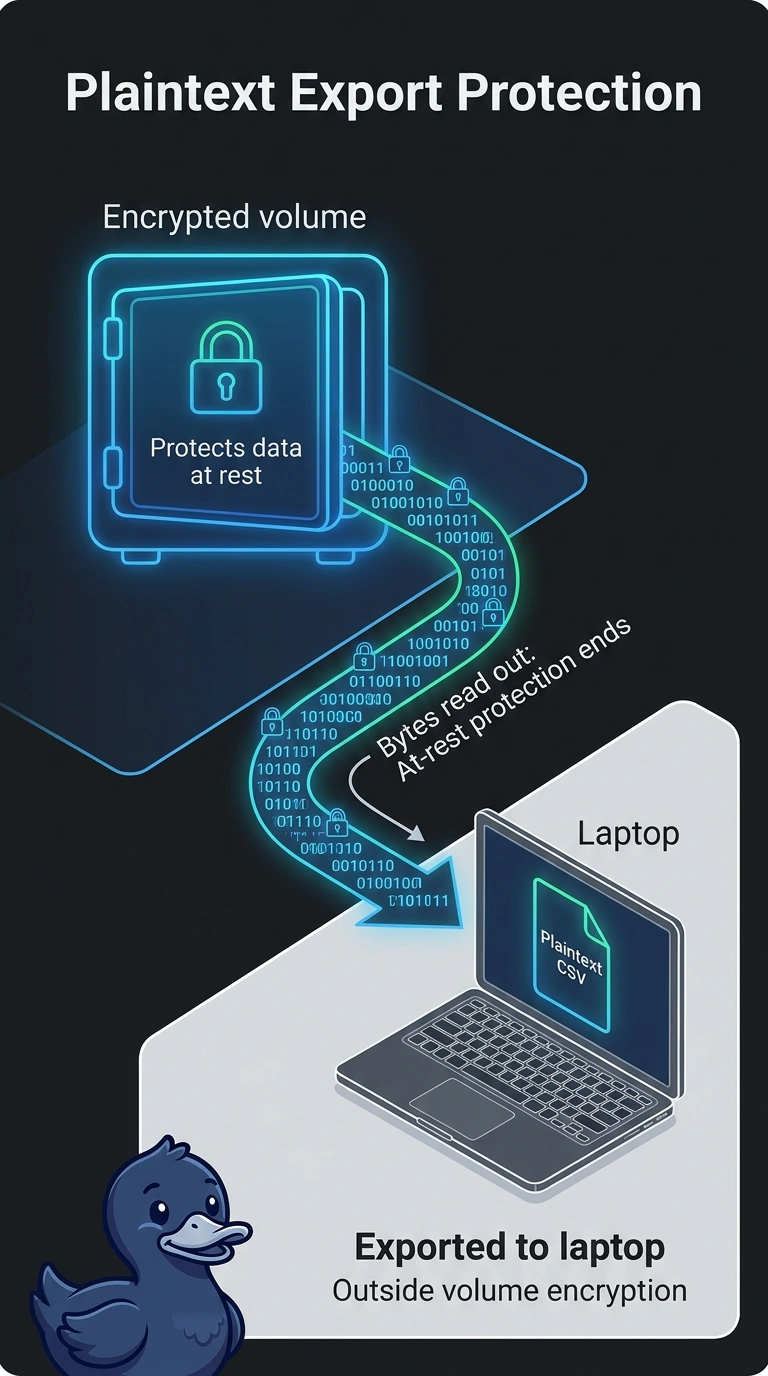
A locked drawer does not stay locked around a photocopy you already carried out. Volume encryption protects bytes while they sit on that volume, and you should treat the plaintext CSV as having left that protection. A different tunnel type will not scramble the file on the laptop.
Full Explanation
Encryption at rest protects bytes while they are stored, and it ends when an authorized operator reads those bytes out. A plaintext CSV on a laptop is a copy that has left the volume, so the volume setting does not travel with it. Treating the plaintext export as outside the volume encryption is the accurate statement, because protection at rest ends once the bytes are read out. Relying on the volume encryption to keep that exported CSV unreadable after it lands on the laptop assumes the control still wraps a file that was written out in the clear. Changing the lab network tunnel from TLS to IPsec picks a different tunnel and does not keep the exported file encrypted on the laptop disk. Placing a web application firewall in front of storage and expecting it to encrypt the CSV the operator already downloaded asks an HTTP inspection control to protect a file that has already left. On the exam, at-rest encryption is not a control on a copy someone already exported. In operations, inspect the file on the laptop and protect that copy with handling or endpoint controls, rather than pointing only at the volume setting.