
A hotel stores guest-folio exports in a cloud bucket, and each branch already maintains an IPsec tunnel to the cloud firewall. Which statement correctly describes protection for those stored files?
Select an answer to reveal the explanation.
Short Explanation
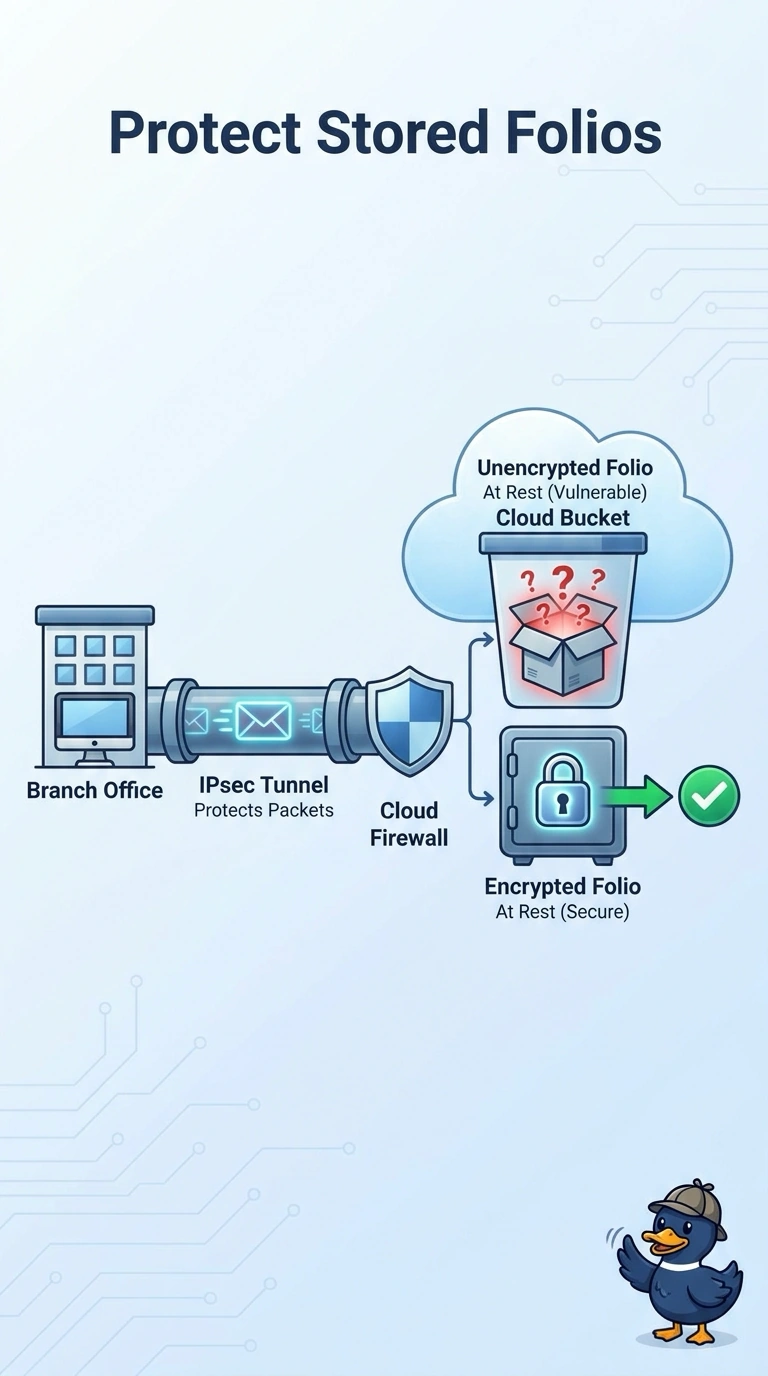
A locked courier van does not lock the shelf after the box is stored. The branch IPsec tunnel protects packets on the way to the cloud firewall, and you still need encryption at rest for a folio file sitting in the bucket. The tunnel does not wrap that stored object.
Full Explanation
IPsec protects packets on a network tunnel. The branch tunnel covers traffic between the branch and the cloud firewall, and a file already sitting in a bucket is not a packet on that tunnel. Encryption at rest is what protects stored bytes. Encrypting the folio object at rest in the bucket is the matching control, because the branch IPsec tunnel only protects packets on the way to the cloud firewall and does not wrap the stored file. Extending the branch IPsec tunnel and treating the bytes sitting in the bucket as encrypted by that tunnel confuses path protection with object protection. Requiring TLS only on the public booking site protects a browser session and leaves the stored folio file without protection at rest. Adding a security group around the storage service limits which network paths can reach the service and does not encrypt the object where it sits. On the exam, a tunnel type does not substitute for encryption of stored data, and a security group is not an encryption control. In operations, check the bucket encryption setting on the folio object and confirm it stands on its own, whether or not the branch tunnel is up.