
A lab terminates IPsec on a concentrator at the data-center edge. Captures on the next hop, between that concentrator and the application servers, show the payload in the clear, and confidentiality is still required there. What should the lab add?
Select an answer to reveal the explanation.
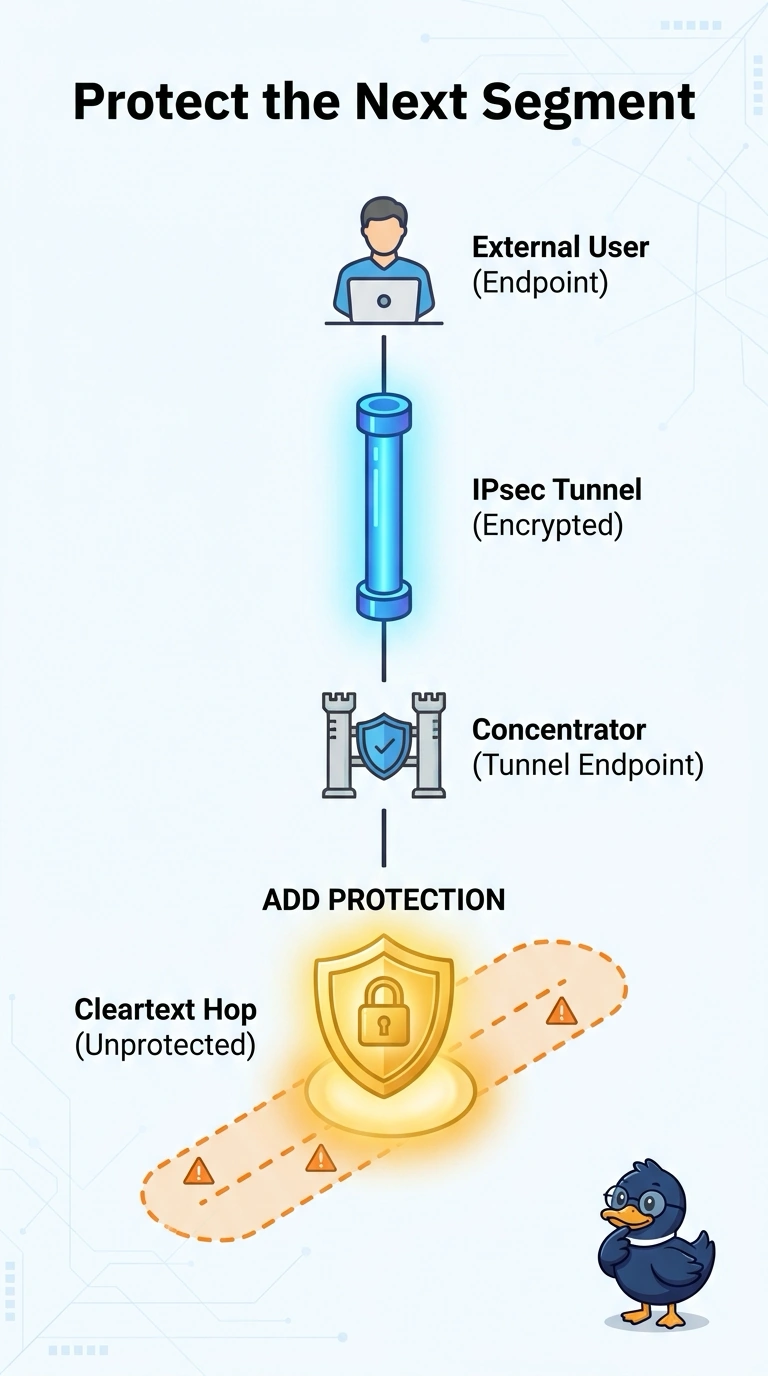
Short Explanation
A covered walkway still dumps you into an open hallway at the door. IPsec ends at the concentrator, so the next hop is cleartext unless you protect that hop on its own. Moving the box to another rack leaves the same gap.
Full Explanation
IPsec protects packets only for the life of the tunnel. When the tunnel ends at a concentrator, the next hop is in the clear unless something else protects that hop. Adding protection on the cleartext hop after the concentrator is what confidentiality still requires, because IPsec stops at the tunnel endpoint and does not cover that next segment. Assuming the IPsec session keeps encrypting packets on the next hop inside the data center extends the tunnel past the place it actually ends. Enabling encryption at rest on the lab database protects stored bytes and does not cover the unprotected network hop between the concentrator and the servers. Moving the concentrator into a different rack and leaving the hop between the tunnel endpoint and the application servers unchanged keeps the payload on that hop in the clear. On the exam, encryption that ends at a concentrator does not follow the packet onto the next segment, and at-rest encryption is not that missing hop protection. In operations, capture on the segment after the concentrator and confirm the payload is protected there, not only on the far side of the tunnel.