
Two hotel booking services must each prove identity to the other before they exchange reservation data. A certificate is installed on only one service, and it identifies that server. Which control completes the requirement?
Select an answer to reveal the explanation.
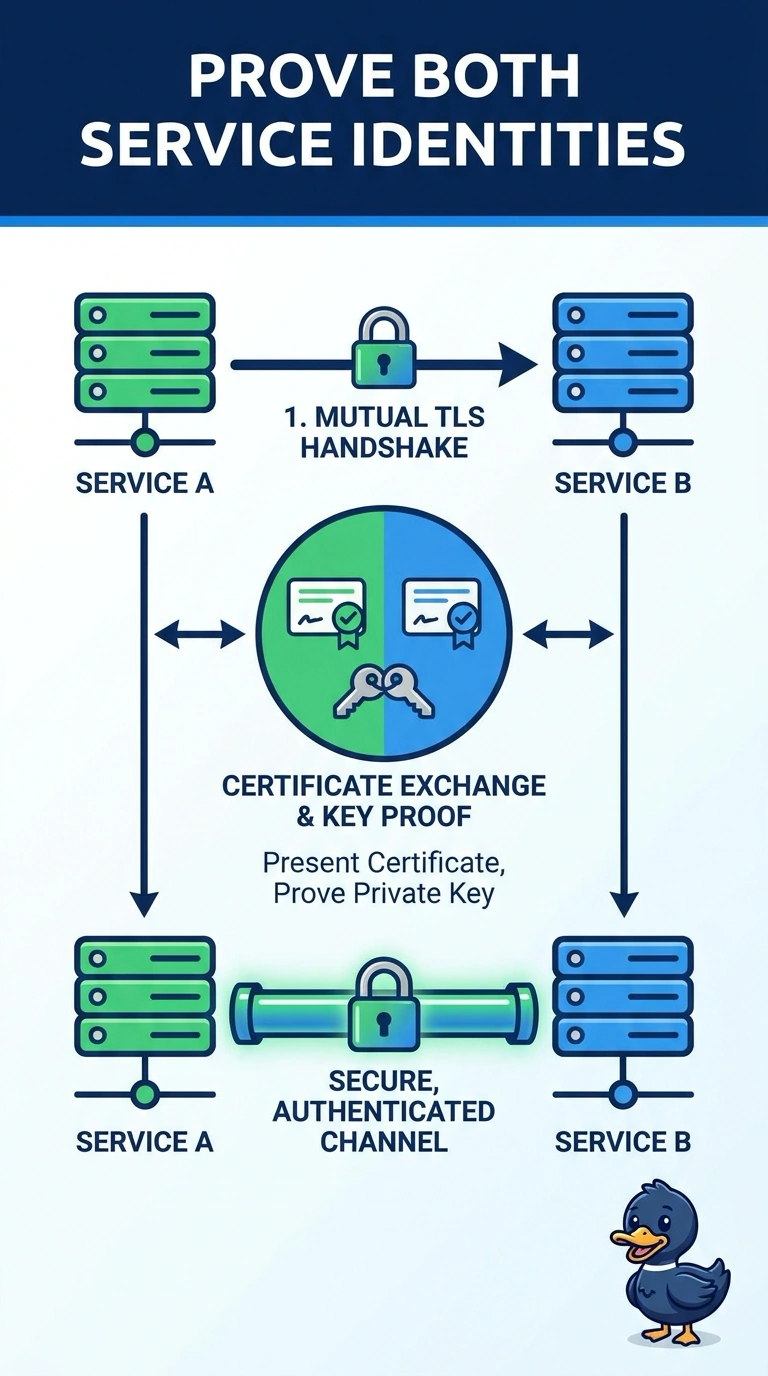
Short Explanation
A name tag on one person does not prove who the other person in the handshake is. A server-only certificate authenticates that server, and you still need the caller to prove its own key. Mutual TLS is how each service authenticates the other.
Full Explanation
A certificate proves possession of a private key to a relying party that trusts the issuer. When two services must each prove identity, each one presents a certificate, which is mutual TLS. A server-only certificate authenticates the server that holds it and does not authenticate the caller. Requiring mutual TLS so each booking service presents a certificate and proves it holds the matching private key completes the requirement. Installing a server-only certificate on one booking service and treating that certificate as authentication of the service calling it authenticates the wrong direction: the caller remains unproven. Encrypting the shared database volume protects stored bytes and is not proof the two services authenticated each other. Placing both booking services on one IPsec tunnel protects the network path, and skipping service identity checks inside that tunnel still does not prove which service is calling. On the exam, a server certificate is not caller authentication, and a tunnel does not replace mutual TLS when each service must prove its key. In operations, confirm both services present certificates during the handshake and that a connection missing the caller certificate is rejected.