
After a connector change, Cisco XDR at a warehouse distribution site stops receiving new Secure Access events. Events that arrived before the change are still searchable. A new test block is visible in Secure Access, but the event delivery log shows it did not reach the configured XDR listener. What restores the arrival of new events?
Select an answer to reveal the explanation.
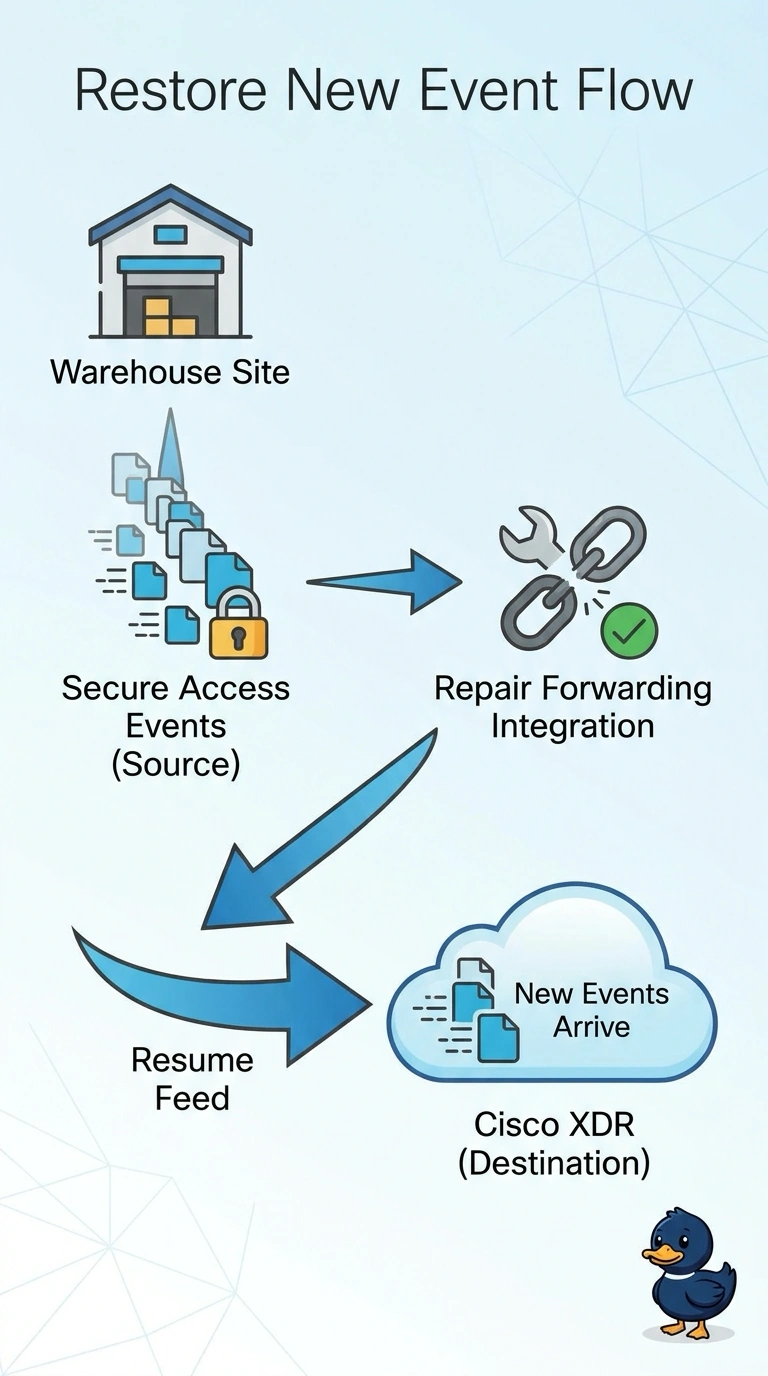
Short Explanation
If the courier stops picking up the mail, rewriting a poster in the lobby does not restart the route. You repair the integration that stopped delivering new events. The trap is editing an access rule that never fed the investigation tool.
Full Explanation
A broken integration stops new events from arriving. The connector change broke the path into Cisco XDR, so you repair the integration that forwards new Secure Access events into Cisco XDR and the feed can resume. Repair the event-delivery integration and verify a new test event reaches XDR. Older events remaining searchable shows the past store is intact and the failure is the new collection. Rebuilding an unrelated web access rule changes policy for traffic that rule matches. That rule does not carry events, and rewriting it does not reconnect the forwarder. Deleting the older events already stored in XDR empties history the analysts can still search. An empty incident list does not force the feed to retry, and destroying retained events hides the record you already have. Disabling HTTPS inspection for every identity changes what the proxy can see inside web sessions. It does not repair a forwarder that stopped after a connector change, and fewer events would make the gap worse. Exam caveat: silence after an integration change is a collection failure, not proof that nothing happened. Operational check: send a fresh test event through Secure Access and confirm a new record with a current timestamp appears in Cisco XDR.