
A school district sees one web block in the Cisco Secure Access console and the same block in Splunk after the event was forwarded. An analyst opened two incidents. How should the team count what happened?
Select an answer to reveal the explanation.
Short Explanation
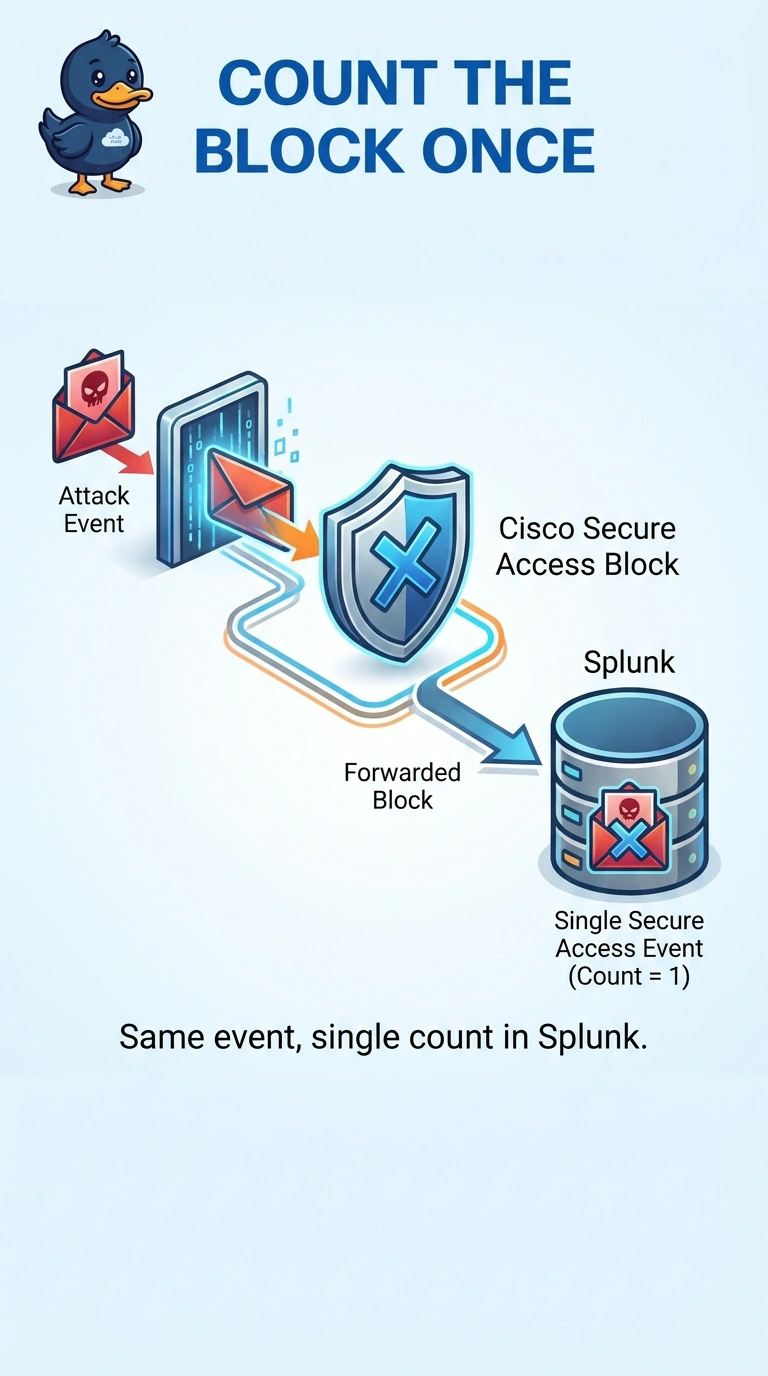
A photocopy of a parking ticket is not a second violation. You can count the Splunk row as the forwarded Secure Access block: one event, not a new attack. Opening two incidents treats one forwarded record as two attacks.
Full Explanation
Forwarding copies a Secure Access event into Splunk. The console block and the Splunk row are two views of the same forwarded block, so count it once; treating them as two attacks mistakes the delivery path for a second compromise and risks directing containment at a duplicate record. Counting two attacks because each view is an independent detection is incorrect: the Splunk row is not a separate attack or a new event requiring its own containment action. Deleting the Secure Access console event and keeping only the Splunk copy is also incorrect. Forwarding does not make the console row a spare sensor, and removing it discards the original sensor view. Disabling forwarding does not recount or change the event already present in both places; it only stops new events from reaching Splunk and blinds the longer investigation. Exam caveat: two different blocks for the same user can still be two events when their destination, time, or reason differ. Practical check: match the user, destination, and time in the console to the Splunk row, then close one incident as the forwarded copy.