
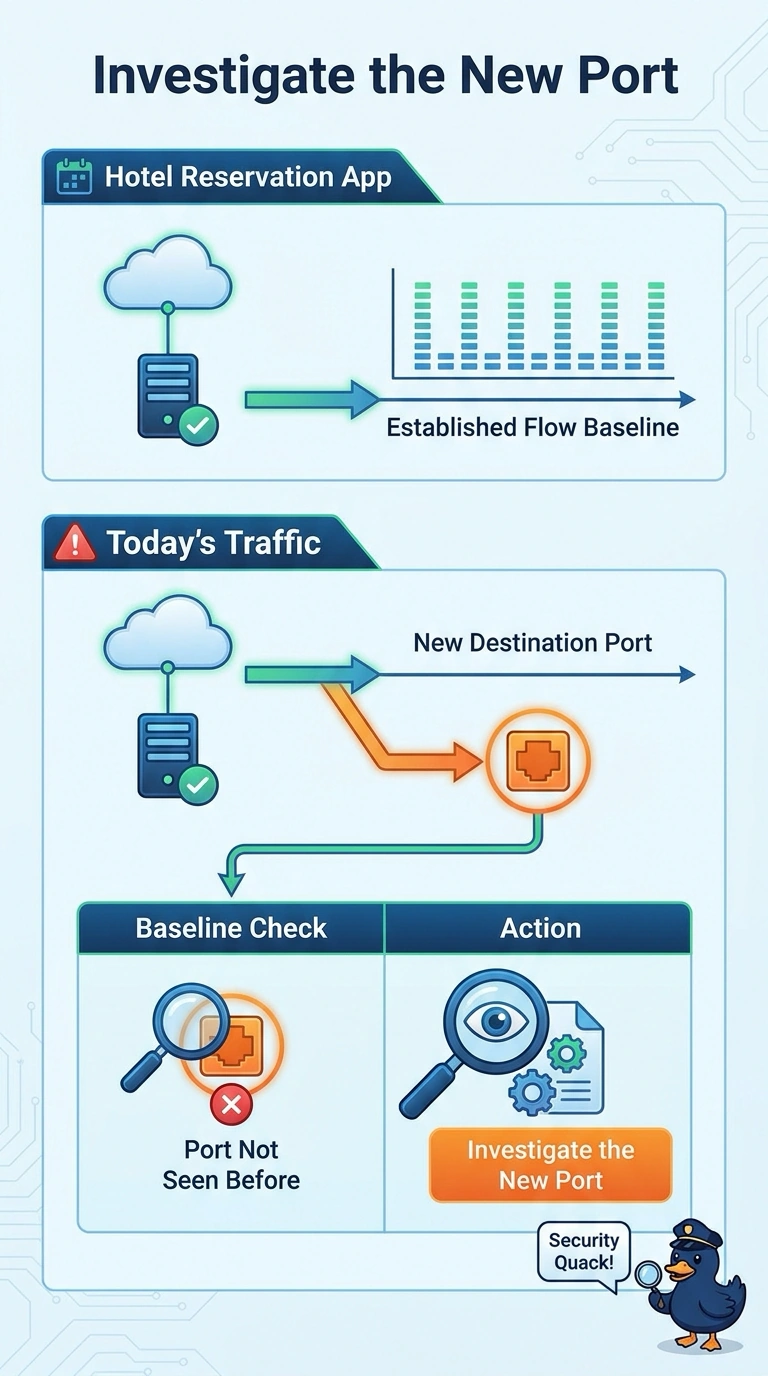
A hotel reservation application has an established flow baseline that has not included one destination port, and that port appeared in today's traffic. What should operations do about the new port?
Select an answer to reveal the explanation.
Short Explanation
When the usual delivery van turns down a street it has not used before, you do not redraw the map and call that street normal on day one. Investigate the destination port because this application's baseline has not included it. The trap is raising a threshold so the new port disappears into the noise.
Full Explanation
A baseline is the set of conversations an application has already established. A destination port that the reservation application's baseline has not shown before is a new conversation, so you should investigate it rather than absorb it on the first sighting. Raising the baseline threshold to fold the new port into normal traffic hides the change, much as raising a threshold can hide a new beacon. Packet loss on a wide-area path and a previously unseen destination port are different signals; the new port alone does not show that the reservation database tier is down. A new autoscaled address with a stable identity is a reason not to treat that address as an intruder, but that guidance does not apply to a destination port the application has not used before. Exam caveat: policy denies are also different from packet loss, and mixing those graphs can send an investigation to the wrong tier. Practical check: compare the new port with the application's approved dependency list and the prior baseline window, and open an investigation if it is not an expected reservation flow.