
At a warehouse, one host using a known identity looks up a rare name overnight, while that identity's baseline is business-hours lookups only. What should operations do with that host?
Select an answer to reveal the explanation.
Short Explanation
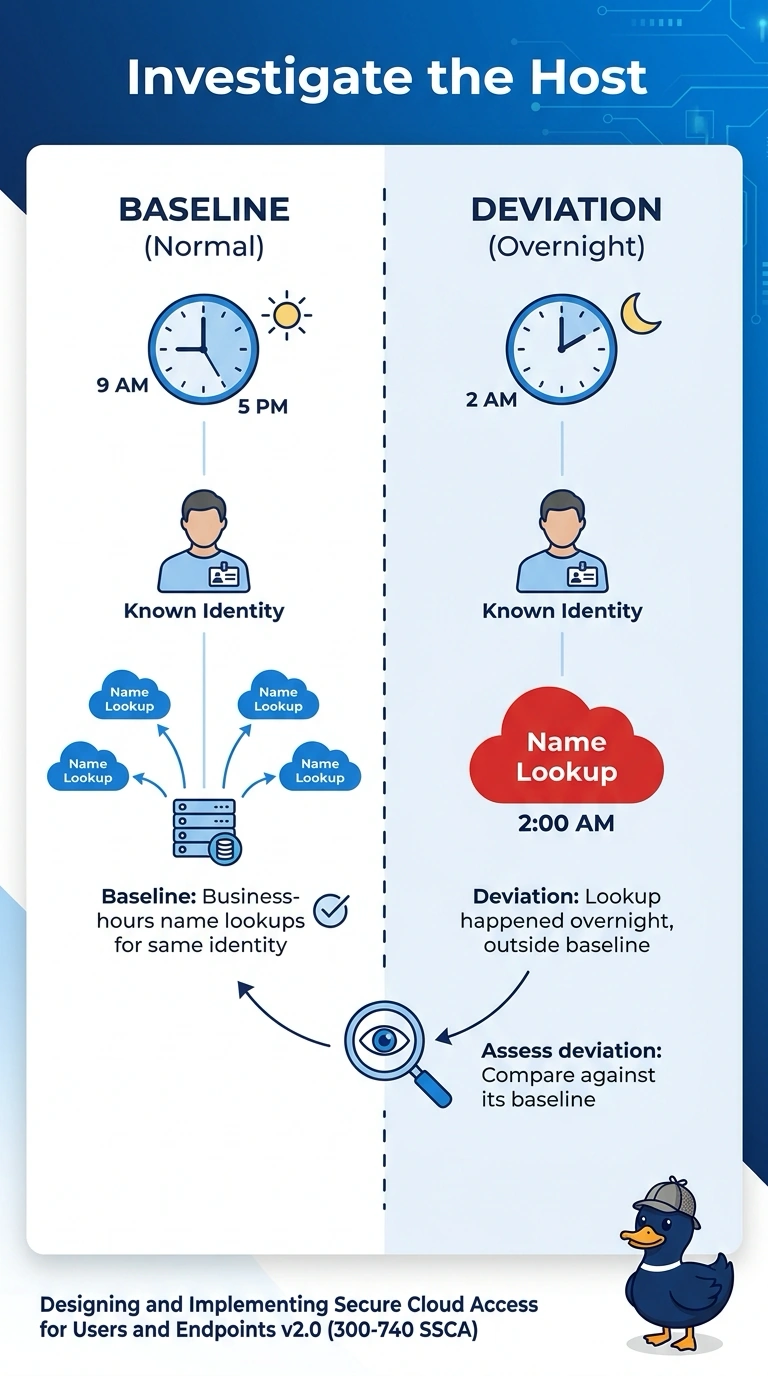
A night watchman knows who is supposed to walk the floor during the day, and a stranger in the middle of the night stands out. You investigate that one host, because a rare overnight name breaks the business-hours baseline for the identity. A flat site-wide processor graph hides the lookup instead of explaining it.
Full Explanation
The useful comparison is the identity's own baseline: business-hours name lookups, not a building-wide average. You investigate that single host against the baseline of business-hours name lookups for the same identity, because a rare name at night is the deviation. The choice to review the site-wide CPU average for the warehouse and close the case when that overnight graph looks flat uses a processor signal that does not show which name was queried or by which host. The choice to raise the name-lookup threshold until the rare overnight query no longer stands out from ordinary noise hides the deviation, and raising a threshold to quiet a new beacon hides the incident. The choice to flush the resolver cache on every warehouse scanner and treat the rare name as a leftover cache entry assumes a stale cache entry, which does not explain a lookup that falls outside the identity's hours and name set. Exam caveat: a stable identity string does not cancel a rare behavior, and a processor graph is a different signal from a name lookup. Operational check: pull the lookup log for that host, compare the name and the time with the baseline for the same identity, and keep the host in scope until the query is explained.