
A university security team needs to learn which public generative AI sites staff use from campus and from home. Which capability matches that job?
Select an answer to reveal the explanation.
Short Explanation
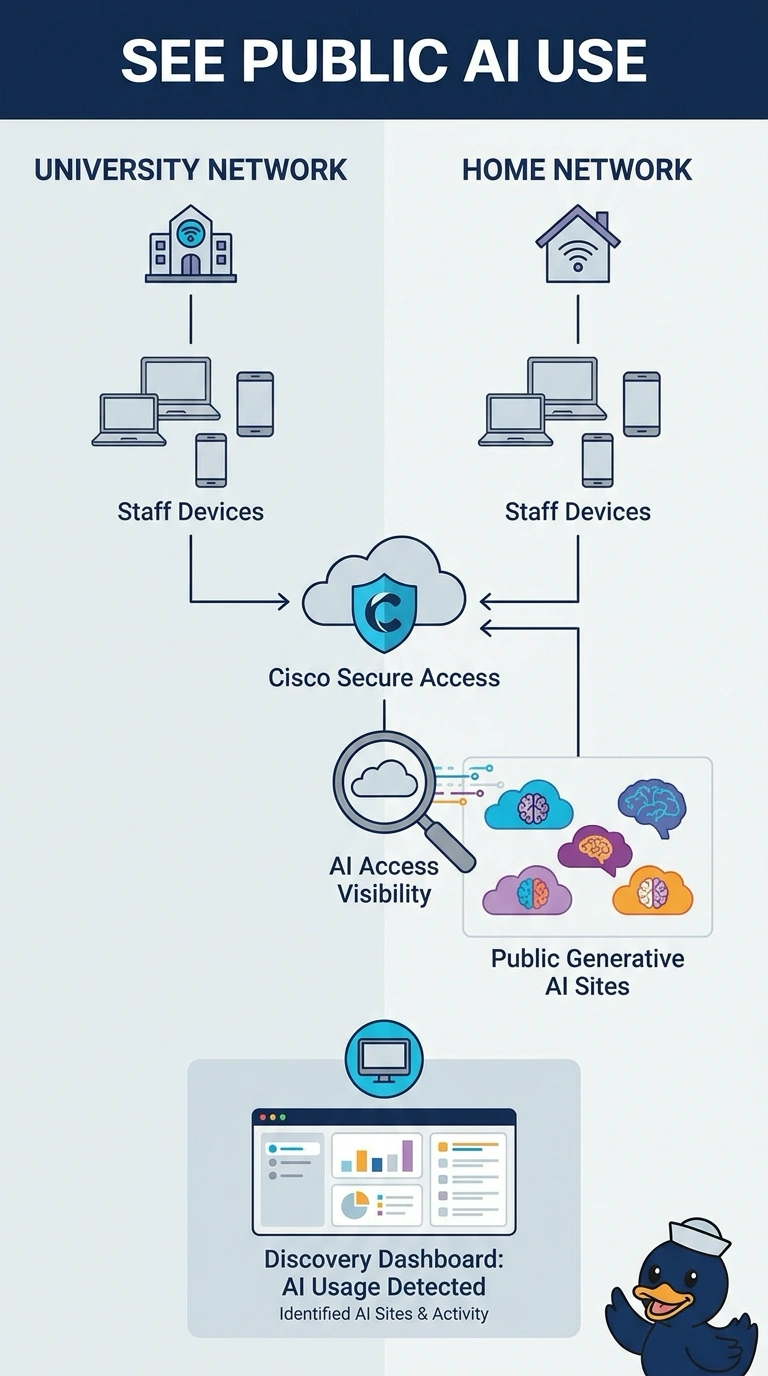
Counting tools on a workshop bench does not tell you which websites people open on their phones. You discover employee use of public generative AI sites with AI Access visibility. Tetragon on a cluster node watches process activity there, not that internet inventory.
Full Explanation
AI Access discovers public AI use when Secure Access inspects the relevant web traffic. Apply that coverage to the campus and roaming traffic in scope. That visibility is the job when the question is which public generative AI sites staff use. Using AI Access visibility in Cisco Secure Access to discover which public generative AI sites staff are using is the matching capability. Installing Tetragon on a cluster node and using its process sensor to inventory the public generative AI sites staff visit points a kernel runtime sensor at an internet-usage question it does not answer. Treating Cilium pod-network flows as the inventory of public generative AI sites employees open confuses pod traffic with a catalog of public sites. Running AI Defense model validation and reading that report as the list of third-party chatbots the staff use mixes up model validation for an application the enterprise ships with discovery of shadow AI tools. On the exam, employee use of public generative AI is AI Access, and validation of a model the organization ships is AI Defense. In operations, review AI Access results for this population and confirm they list third-party AI destinations, rather than a Tetragon runtime alert or an AI Defense validation result.