
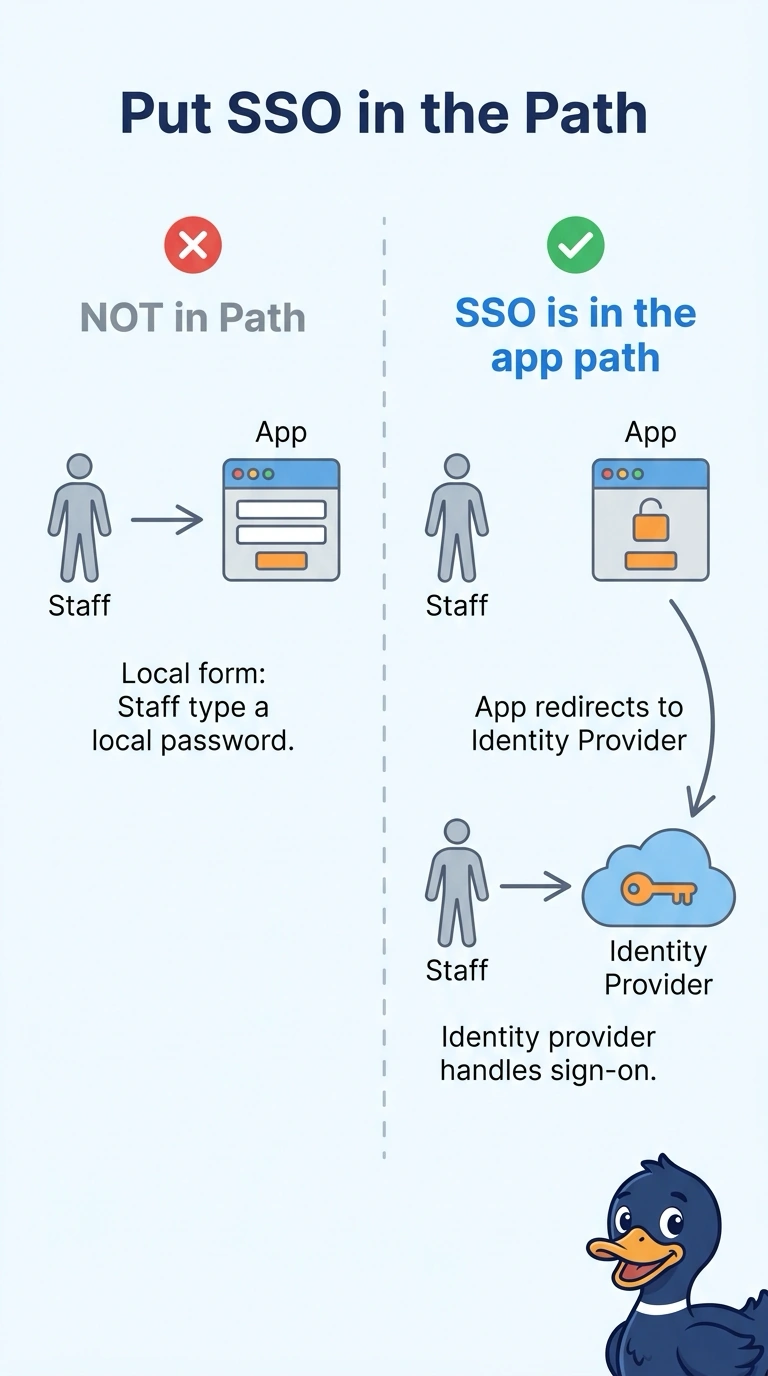
A hotel chain turned on single sign-on for its housekeeping application in the identity provider, yet staff still type a local password on the application's own form. What is still missing?
Select an answer to reveal the explanation.
Short Explanation
Turning on the lobby intercom does nothing if the side door still has its own keypad. Single sign-on is enabled at the identity provider, but staff still use a local password form, which means the application is not redirecting. You fix the application so sign-in actually leaves for the identity provider.
Full Explanation
Single sign-on works when the application sends the user to the identity provider. Staff are still typing a password on the housekeeping form, so the application is not redirecting and single sign-on is not in the path. The missing piece is a redirect from the application to the identity provider, because the local password form means single sign-on is not actually in the path. A new SCIM bearer token lets provisioning create and update accounts. It does not move the browser off the local password form, and it is not the sign-in redirect. A shorter SAML assertion lifetime changes how long a signed login statement is accepted after a redirect already exists. It does not explain why the housekeeping application still shows its own password form. An endpoint posture agent measures the device. A disk-encryption pass is not what hides the local password form, and posture does not turn on the redirect. Exam caveat: enabling the application inside the identity provider without changing the application's own sign-in page leaves the local form in place. Operational check: open the housekeeping sign-in page in a fresh browser session and confirm the browser is sent to the identity provider before any local password is accepted.