
A university platform team must stop a forbidden process action inside a Kubernetes node at the moment the process makes the system call. Which control can do that job?
Select an answer to reveal the explanation.
Short Explanation
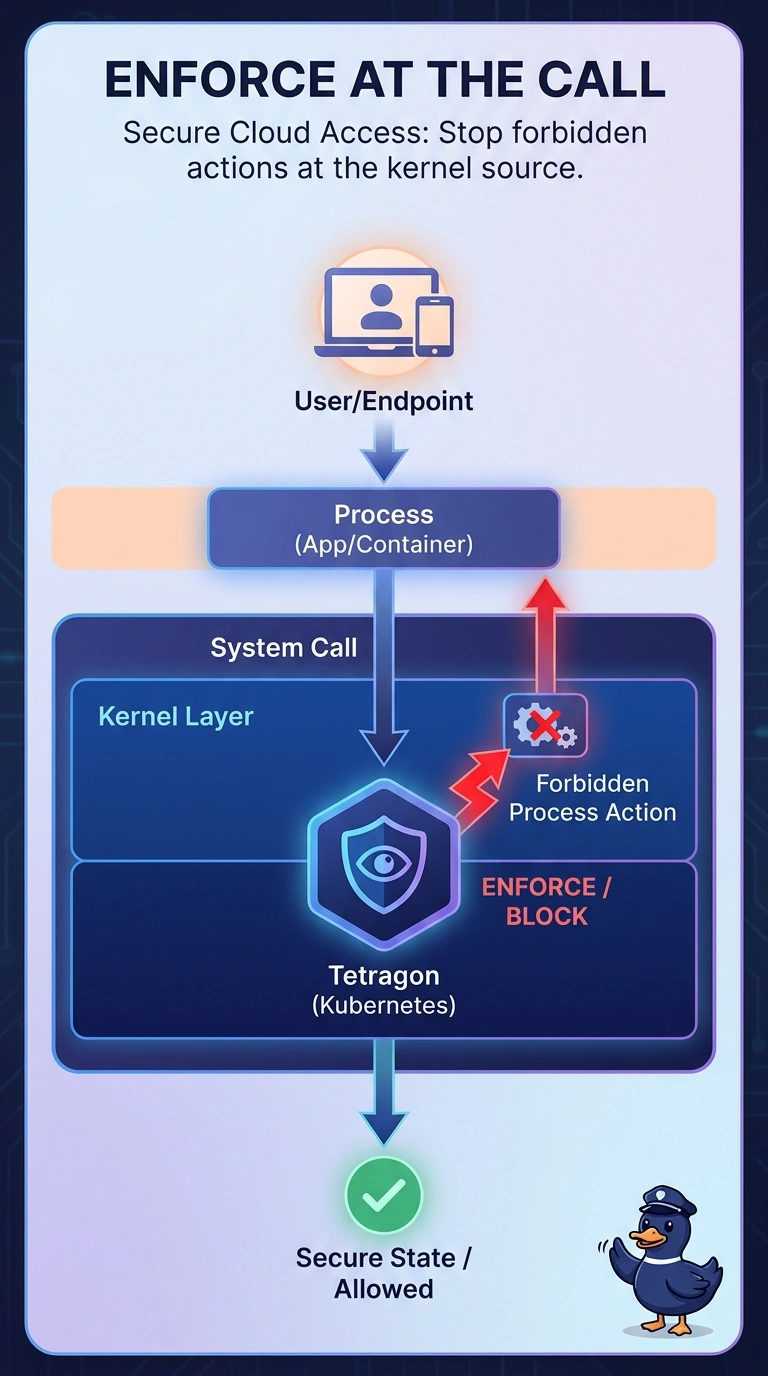
A fence at the property line cannot grab a hand inside the workshop. You want Tetragon, which can see the process action and enforce it in the kernel. A cloud security group at the network edge does not see that system call.
Full Explanation
Tetragon is the runtime sensor that watches process, system call, and file activity and can enforce in the kernel. Use it at a supported hook, with an Override action to prevent the operation and a signal action when process termination is also required. A forbidden process action at the system call, inside the node, is that job. Selecting Tetragon so the node can observe the forbidden process action and enforce against it in the kernel matches the requirement. Selecting a cloud security group at the network edge and expecting that group to see and stop the system call asks a network filter to observe an in-kernel event it does not receive. Selecting the secure web gateway and writing a user web rule aimed at the forbidden process action points a user web proxy at something that is not user web traffic. Selecting Cilium network policy by itself can allow or deny pod traffic, and treating a denied packet as the same control as stopping the process confuses network policy with runtime enforcement. Cilium is the data plane for pod identity and network policy. On the exam, runtime process enforcement on a node is Tetragon, and pod network policy is Cilium. In operations, reproduce the forbidden action on a test node and confirm Tetragon records the system call and enforces there, while a security-group change at the cloud edge does not.