
A research lab wants every summer intern to receive a limited role in the lab notebook application without an administrator assigning a license by hand for each person. The application supports mapping a SCIM-provisioned group to its limited role and license. What should provisioning do?
Select an answer to reveal the explanation.
Short Explanation
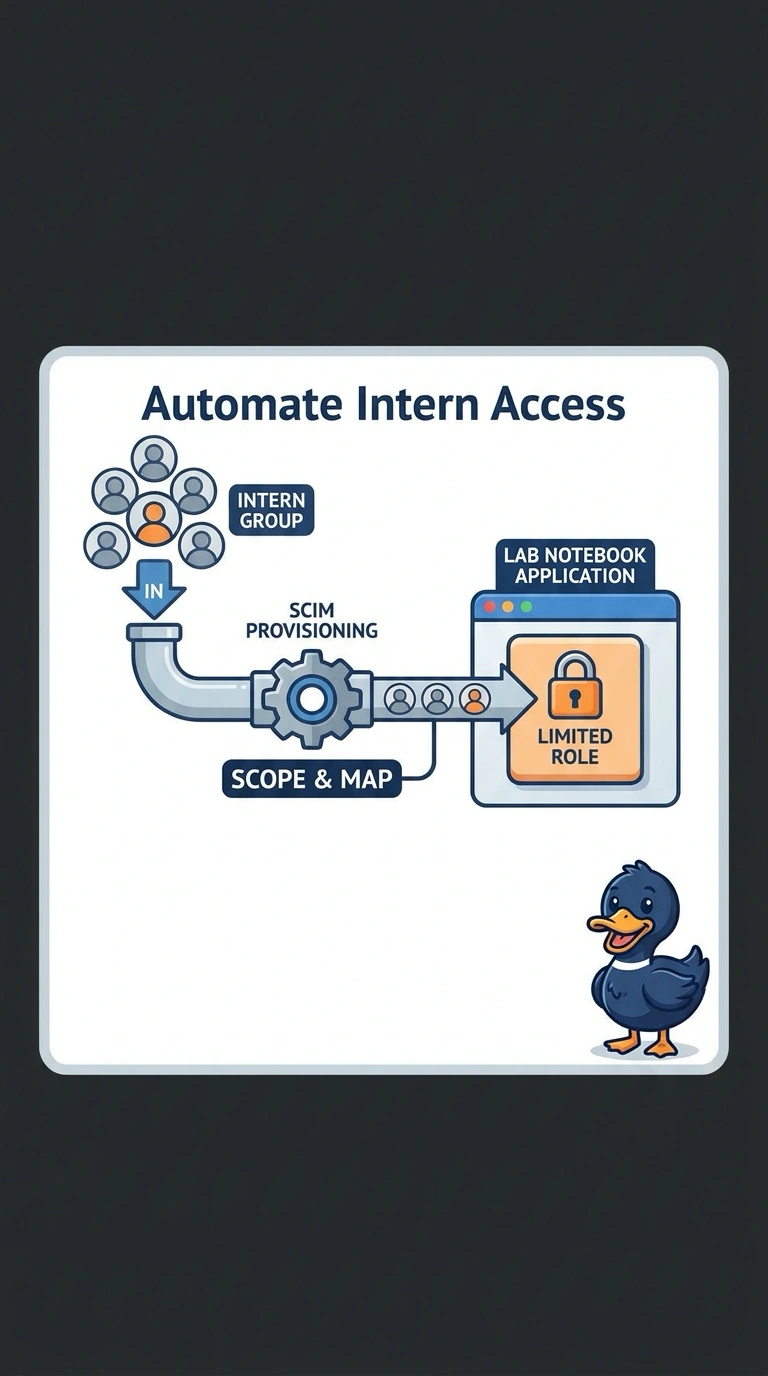
You hand the summer crew one kind of badge at the door instead of engraving each badge by hand. Scope provisioning to the intern group and map that group to the limited role. Sign-in alone does not assign the license the lab is trying to grant.
Full Explanation
SCIM creates and updates accounts for the people in scope, and it can map a group to a role so interns are not licensed one by one. Scope SCIM provisioning to the intern group and map that group to the limited role in the lab notebook application. The application assigns the limited role through its configured group mapping. Enabling SAML for the intern group authenticates those users. An assertion does not assign the limited license, because sign-in is not the provisioning step that creates the account or the role. Turning on just-in-time creation for the whole directory builds accounts at first login for a much wider population. It hands each intern a full account for an operator to trim later, which is the manual work the lab is trying to avoid, and it does not map the intern group to the limited role. Replacing the SAML signing certificate when each intern arrives rotates the login signing key. It does not issue a fresh limited account for that person. Exam caveat: a group that also contains staff will grant those staff the intern role if the scope is wider than the summer cohort. Operational check: add a test intern to the group, run provisioning, and confirm the lab notebook shows the limited role while a user outside the group receives nothing.