
A factory identity team expects SAML login to delete the SaaS account on the human-resources termination date and to measure disk encryption on the laptop. What does that SAML trust actually do?
Select an answer to reveal the explanation.
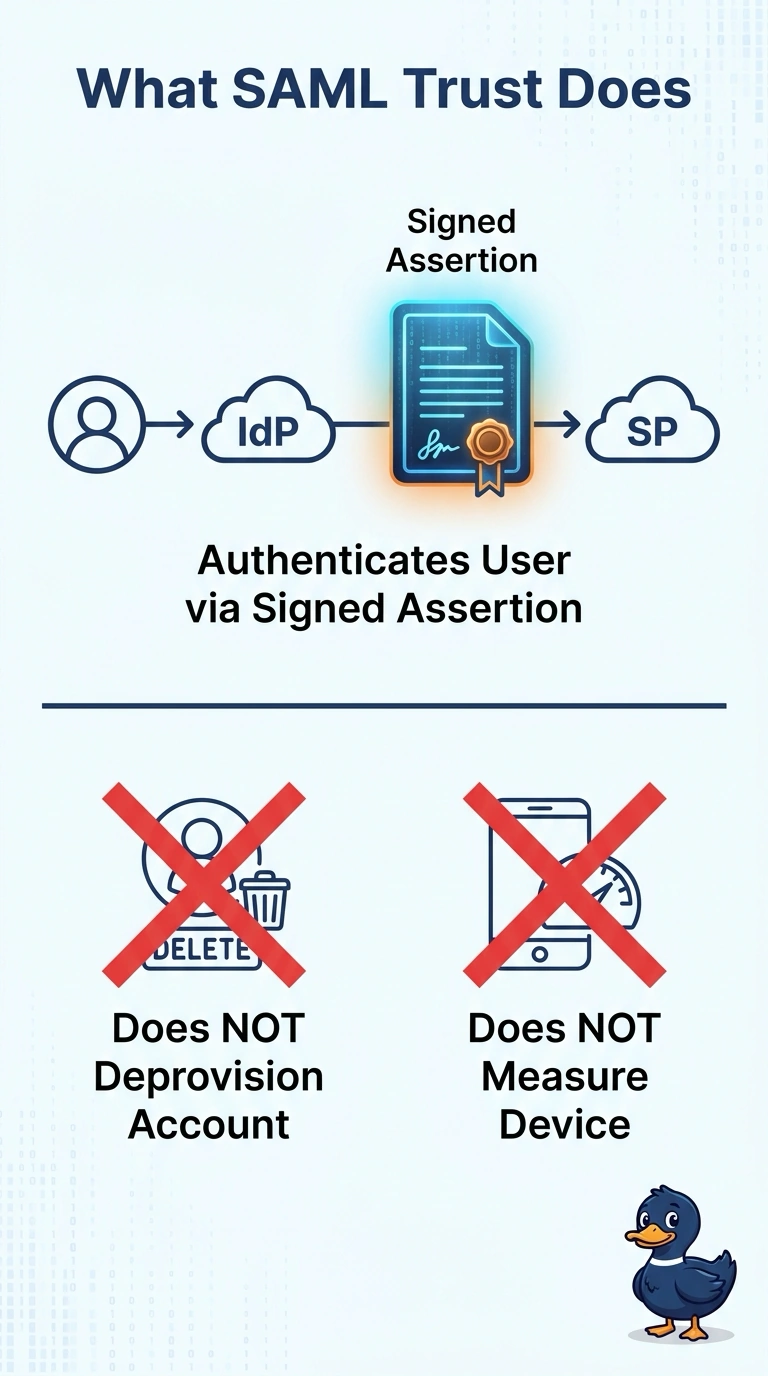
Short Explanation
A badge reader opens the door for you today, but it does not cancel the badge on Friday or check the lock on your laptop. SAML authenticates the user with a signed assertion and stops there. It does not deprovision the SaaS account or measure disk encryption.
Full Explanation
SAML logs the user in. The service provider trusts a signed assertion from the identity provider, and that is the job this trust performs. It authenticates the user and does not deprovision the account or measure the device. Expecting the login to delete the SaaS account on the termination date asks SAML to do provisioning work it does not do. Just-in-time creation on first login also does not remove a terminated person, and a login that nobody performs on that date cannot be a cleanup. Reporting whether the laptop disk is encrypted is endpoint posture, which needs an endpoint check, not an assertion. Measuring endpoint posture at every login and removing the SaaS account even when the person never signs in again describes a posture agent plus a provisioning protocol, not the SAML trust. Replacing both SCIM deprovisioning and the posture check with a successful login leaves terminated accounts in place and never evaluates disk encryption. SCIM is what creates, updates, and deprovisions accounts. Exam caveat: an application that still shows a local password form is not actually sending users through this SAML path, so the assertion is not even the login. Operational check: disable a test account in the identity provider, confirm SAML no longer signs that person in, and confirm the SaaS account still exists until the provisioning job removes it.