
A hotel needs staff to open a scheduling application with single sign-on and no local password, and needs each account removed automatically when employment ends. Which design meets that pair of outcomes?
Select an answer to reveal the explanation.
Short Explanation
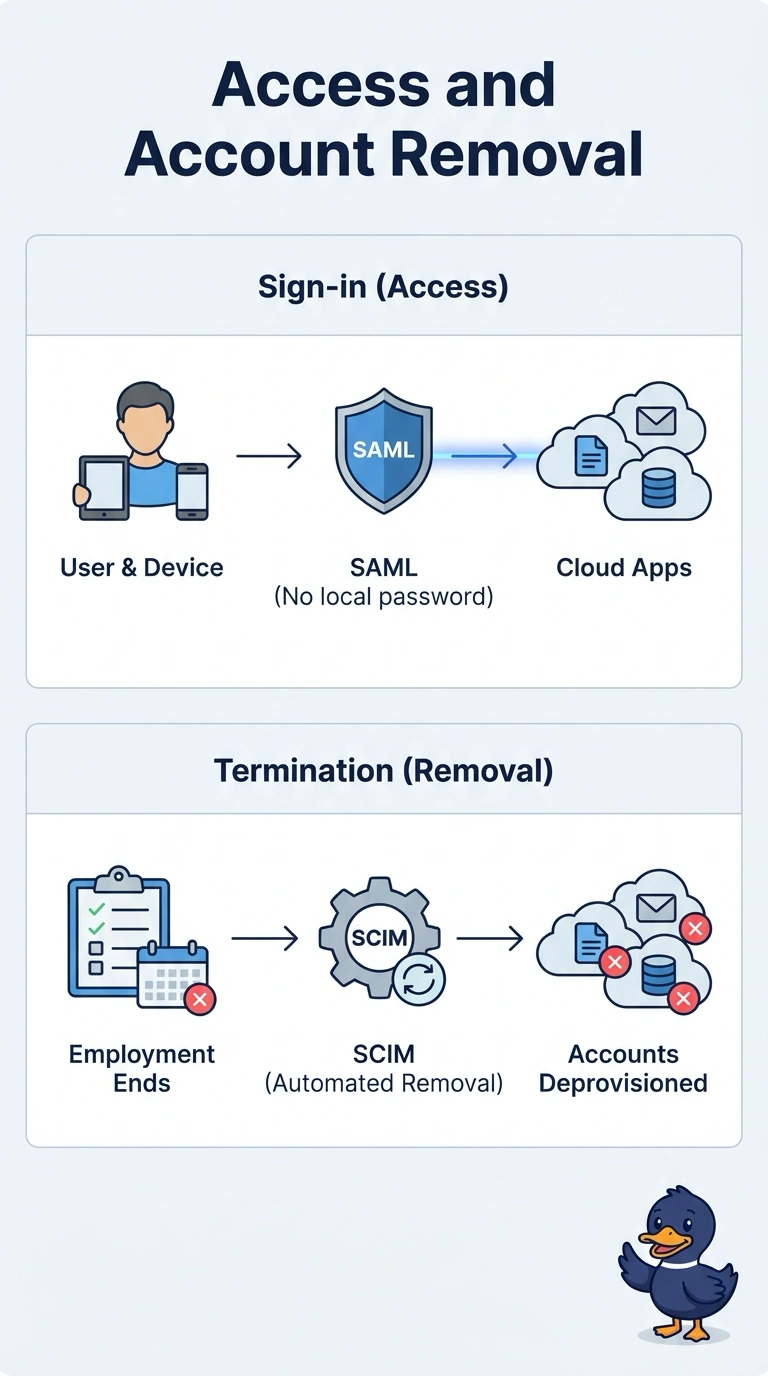
A key that opens the door does not pack the office when someone leaves, and a mover does not check people in. You need SAML for the sign-in and SCIM for the removal, because each one does only its own job. The trap is expecting one of those two to cover both outcomes.
Full Explanation
SAML is the sign-in. It lets the user enter without a local password when the application actually redirects to the identity provider. SCIM removes or disables the account when employment ends, which a login protocol does not do. The design that meets the hotel outcome uses SAML so the user signs in without a local password, and uses SCIM to remove the account when employment ends. Relying on SAML alone expects a signed assertion to delete the account at termination, and an assertion does not deprovision anyone. Relying on SCIM alone expects the provisioning token to complete the interactive sign-in. A provisioning token creates and updates accounts. It does not authenticate the person at the login page. Keeping a local password form means single sign-on is not in the path, and waiting for a failed login does not remove a departing employee who simply never returns. Exam caveat: a password entered on the application's local form uses the local sign-in path. SAML SSO can also start from the IdP and return a signed message to the application. Operational check: sign in as a test user and confirm the browser redirects to the identity provider with no local password, then disable that user and confirm the application account is removed by the provisioning feed.